













How do you get pregnant after egg freezing? The purpose of egg freezing is to preserve your eggs for the future. When you are ready to get pregnant and want to use your frozen eggs, you will usually need in vitro fertilization (IVF). The eggs are thawed and fertilized with sperm, and the resulting embryo is then transferred to the uterus to achieve pregnancy.
This article walks you through how pregnancy works after egg freezing and outlines the IVF process from thawing to transfer. It also covers who may want to consider egg freezing, the recommended timing, and common questions, so you can better understand your direction and options when planning your fertility.
How Do You Get Pregnant After Egg Freezing?
If you plan to get pregnant after freezing your eggs, you don't necessarily have to use them. If you ovulate normally and have a stable partner, you can still try to conceive naturally first. If you get pregnant during that time, your frozen eggs won't be needed.
If you later decide to use your frozen eggs, you will need in vitro fertilization (IVF) to conceive. Egg freezing can be seen as part of the IVF process. When you are ready to try for pregnancy, the following steps come next:
-
Thawing the eggs: The eggs are removed from liquid nitrogen at -196°C (-321°F) and thawed. Vitrification is now widely used, and the survival rate after thawing is generally above 90%, similar to that of fresh eggs, although it is still affected by the age at which the eggs were frozen.
-
Fertilizing the eggs with sperm (in vitro fertilization): The thawed eggs are fertilized in the lab using intracytoplasmic sperm injection (ICSI), in which a single sperm is injected into each egg, to improve the consistency of fertilization. The fertilization rate is about 70-80%.
-
Embryo culture and preimplantation genetic testing (PGT): After fertilization, the embryos continue to be cultured until Day 3 or Days 5-6. In certain situations, the doctor may consider whether to arrange preimplantation chromosomal testing (PGT). Whether it is suitable depends on your age, the number of embryos, your medical history, and your overall treatment goals, and is discussed case by case.
-
Embryo transfer and luteal support: The doctor places the embryo into the uterus through a thin catheter, and the procedure usually does not require anesthesia. After the transfer, progesterone is given to help keep the uterine lining stable and provide an environment for the embryo to implant.
-
Pregnancy test and follow-up: A pregnancy test can be taken about 10 to 14 days after the transfer to confirm whether the embryo has implanted. If you are pregnant, follow-up continues according to general reproductive medicine and obstetric guidelines. Current data show no higher rate of congenital abnormalities in babies born from thawed frozen eggs than in other IVF babies.
In TFC Taipei Fertility Center's clinical experience, many patients feel anxious about the process before treatment begins. With a thorough evaluation and step-by-step explanations, most feel more at ease going into treatment and have a clearer understanding of the purpose and arrangement of each stage.
Am I a Good Candidate for Egg Freezing? Groups Who May Want to Consider It Early
Egg freezing can be broadly divided into "medical freezing" and "social freezing." The motivations differ, but the core purpose is the same: to preserve fertility in advance. Here is a detailed explanation from TFC:
Medical Egg Freezing
Medical egg freezing is mainly done to preserve eggs before treatments that may affect ovarian function, lowering the risk that future fertility will be affected. Groups who commonly benefit include:
-
Cancer patients: Chemotherapy or radiation therapy may affect ovarian function, so it is recommended to preserve eggs before treatment begins.
-
Gynecologic conditions: For women with benign ovarian conditions (such as chocolate cysts caused by endometriosis) who need ovarian surgery, egg freezing may be considered beforehand to avoid damage to ovarian function after surgery.
-
Low ovarian function: Women who are still young but have been assessed by an obstetrician-gynecologist or reproductive medicine specialist as being at risk of declining ovarian reserve can also discuss egg freezing early. The assessment usually takes into account age, AMH, ultrasound findings, and overall medical history.
-
Family history: Women with a family history of premature ovarian insufficiency (POI) may face an earlier decline in egg reserve and are well suited to plan ahead.
Social Egg Freezing
Thanks to advances in vitrification technology, social egg freezing allows healthy women who wish to delay having children because of career plans, relationship status, or other personal factors to keep their options for future pregnancy open. Suitable candidates include:
-
Women with no current plans to have children: Women under 40 who do not yet plan to have children. Single women over 30 who have not yet met a suitable partner can start discussing egg freezing plans with a fertility center.
-
Age considerations: Women aged 35 or older with no current plans to have children. Age 35 is often regarded as a turning point for egg quality, after which ovarian function tends to decline more quickly, so freezing sooner may help preserve eggs of better quality.
-
Partner factors: If a partner has a condition such as azoospermia or other abnormal semen factors that temporarily prevents conception, eggs can be preserved first for later plans.
-
Career planning: Many women who consult TFC are in the middle of building their careers. By planning ahead, they can keep more flexibility and choice as their lives move at different paces, and so choose egg freezing.
Read more:
Egg Freezing Guide 2026: Ideal Age, Process, Costs & Success Rates Explained
When Should You Freeze Your Eggs? Ideal Age and Recommended Number of Eggs
The most important factor in deciding when to freeze your eggs, and how many to store, is age. Age directly affects egg quality and also the chance of a live birth in the future. According to recommendations from the American Society for Reproductive Medicine (ASRM) and the European Society of Human Reproduction and Embryology (ESHRE), the ideal time to freeze eggs is generally before age 35, because the younger you are when eggs are preserved, the higher the chance of success when they are used later. The younger you are and the more mature eggs you freeze, the higher the chance of at least one live birth in the future. Many studies use 15-20 mature eggs as a common target for improving the chance of at least one live birth, but this is not a guaranteed figure.
Some eggs are naturally lost as they go through thawing, fertilization, culture, and implantation, so having a sufficient number helps improve the overall chance of success. Most plans aim to accumulate enough mature eggs, but the actual target number should still be assessed individually based on age, ovarian reserve, and fertility goals. Below, we summarize the recommended number of eggs to store at different ages in a table, to help you better understand when to plan:
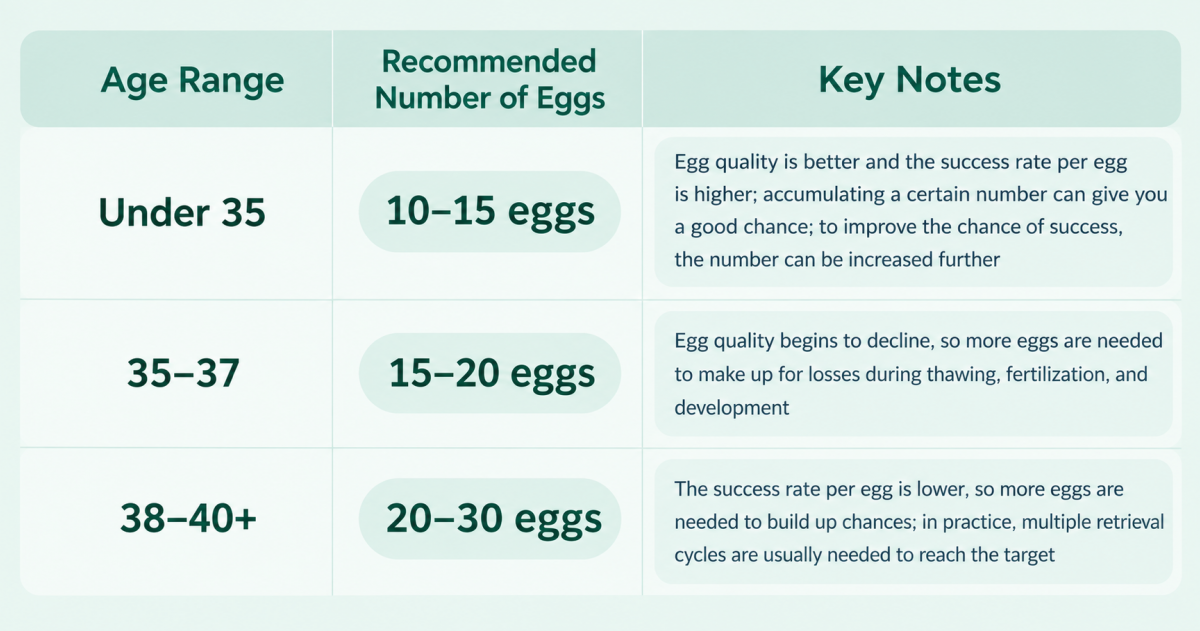
Overall, the key to egg freezing is not just how many eggs you freeze, but when you freeze them. TFC Taipei Fertility Center can help assess the right timing and target number of eggs based on your age, ovarian function, and fertility plans, so your planning rests on a clearer basis.
How Do You Get Pregnant After Egg Freezing? The 7 Most Common Questions About Egg Freezing
Q: Do I need my partner's consent to freeze my eggs?
The egg freezing procedure itself does not require your partner's consent. Even single women can freely and legally undergo social egg freezing to keep their future fertility options open.
Please note, however, that under Taiwan's Assisted Reproduction Act, if you later want to use your frozen eggs for in vitro fertilization (IVF) in Taiwan, you must meet the Act's current eligibility requirements for a "married couple undergoing treatment."
Q: What Is the Best Age to Freeze Your Eggs?
It is generally considered that between ages 30 and 35 is a good window for egg freezing, because egg quantity and quality are still relatively favorable at this stage. If you are around 30, not yet married, and have no immediate plans to get pregnant but want to have children in the future, you can start assessing whether egg freezing is right for you.
Q: Is Egg Freezing Guaranteed to Work?
No. Egg freezing cannot guarantee a future pregnancy. From thawing and fertilization, to development into a blastocyst, transfer to the uterus, and successful implantation, some eggs may be lost at every stage, and not every egg will develop into a baby. The final chance of pregnancy mainly depends on your age when the eggs were frozen and the number of eggs stored.
Q: How Many Eggs Can Be Retrieved in One Cycle?
The number of eggs retrieved in one cycle varies from person to person and is mainly affected by age, ovarian reserve (such as AMH), and how the body responds to ovulation medication. In general, younger women with better ovarian function may have 10 or more eggs retrieved in one cycle. As age increases, egg numbers gradually decline, and only a few eggs may be retrieved, so multiple cycles may be needed to accumulate enough eggs.
Q: What Does the Egg Freezing Process Involve, and How Long Does It Take?
The egg freezing process is relatively straightforward and usually takes about 14 days. In most cases, it does not noticeably disrupt daily life or work. It is divided into 4 main stages:
- Pre-treatment assessment (cycle days 1-3): Blood tests check hormone levels and AMH, and a transvaginal ultrasound assesses the baseline (antral) follicle count. These results are used to plan the rest of the cycle.
- Ovarian stimulation (starting on cycle days 2-4): You begin injectable or oral medication to stimulate the ovaries. During this time, you will return for about 3-4 monitoring visits, where ultrasound is used to track follicle development and size.
- Trigger shot: When the follicles reach the right level of maturity, you take a trigger shot at a specified time to help the eggs complete their final maturation.
- Egg retrieval: The eggs are retrieved about 35-36 hours after the trigger shot. They are taken to the lab immediately and preserved using vitrification.
Q: Is Egg Freezing Painful?
Most people report low levels of discomfort with egg freezing, so there is no need to worry excessively. Egg retrieval is performed under intravenous sedation, so it feels like sleeping, and the procedure is finished by the time you wake up. The doctor retrieves the eggs under transvaginal ultrasound guidance. The procedure takes about 15 to 20 minutes, leaves no visible wound, and does not require a hospital stay.
After the procedure, your blood pressure and heart rate are monitored in a recovery room to make sure there is no bleeding or other problem, and you can usually go home to rest after about 1 to 2 hours. For a few days afterward, some people may feel lower abdominal bloating or mild discomfort, which is related to the ovaries having been stimulated by medication. If a larger number of eggs was retrieved, the discomfort may be slightly more noticeable, but it is mostly mild and usually eases within a week.
Q: Does How Long Eggs Are Stored Affect Your Chances of Pregnancy?
Current research shows that, under appropriate freezing and storage conditions, the length of storage itself has not been found to noticeably affect later thawing, fertilization, or pregnancy outcomes. In practice, however, results still depend on your age when the eggs were frozen and on egg quality.
Interested in Egg Freezing? Book a Consultation with TFC Taipei Fertility Center
Egg freezing is not just a single procedure. It is a stage of fertility preparation that needs careful planning. From the initial assessment and egg retrieval to long-term storage and future pregnancy arrangements, every step can affect the final outcome, so choosing an experienced, well-equipped fertility center can make the whole process feel more reassuring.
TFC Taipei Fertility Center offers professional egg freezing services. From the first-visit evaluation and ovarian stimulation to egg retrieval and cryopreservation, our professional team plans each step around your individual circumstances. The whole process takes about 2 to 3 weeks. Along the way, blood tests and ultrasounds are used to keep track of follicle development, and medication is adjusted based on how your body responds, so the treatment fits your own physical condition more closely.
If you are considering freezing your eggs, or would like to learn more about the pregnancy process afterward, we welcome you to book a consultation with TFC Taipei Fertility Center. A thorough evaluation and professional explanation can help you better understand your situation and plan your next step with more peace of mind.
Read more: