












Whether you're thriving in your career, enjoying the freedom of single life, or planning your future together with a partner, today's women have more choices than ever — and are no longer bound by the traditional "biological clock." Yet one biological reality remains unavoidable: a woman's ovarian function and egg quality decline naturally over time, and this process cannot be reversed.
Want to pursue your career goals without regret, while keeping the option of motherhood open for your future self? Egg freezing (oocyte cryopreservation) is the fertility insurance you can give yourself today — for peace of mind tomorrow. In this guide, TFC's team of reproductive medicine specialists walks you through everything you need to know about egg freezing: how it works, who it's right for, the ideal age to freeze your eggs, the step-by-step process, the latest costs and subsidies, and what comes next on the path to IVF.
Part 1: What Is Egg Freezing? What's the Best Age to Freeze Your Eggs? Do I Need It?
Egg freezing refers to the process of retrieving a woman's eggs and preserving them using advanced vitrification technology — an ultra-rapid freezing method that stores the eggs in liquid nitrogen at -196°C (-321°F). This instantly halts all cellular metabolism and aging, keeping the eggs in their healthiest possible state until they're needed. When you're ready to grow your family, the stored eggs can be thawed and used to achieve pregnancy through IVF (in vitro fertilization) or IUI (intrauterine insemination).
Both egg quality and quantity decline naturally with age. A woman's optimal fertility window falls between ages 25 and 35, and both egg quality and quantity drop off more rapidly after 35. For this reason, freezing your eggs between ages 30 and 35 is generally considered the most ideal and cost-effective window — and if you go on to need IVF in the future, your chances of success will also be higher.
Who should consider egg freezing? It generally falls into two categories:
1. Elective (Social) Egg Freezing
- You're currently focused on your career or education and aren't ready to have children yet.
- You haven't yet met the right partner, but hope to have children someday.
- You want to proactively safeguard against age-related decline in ovarian function.
2. Medical Egg Freezing
- You've been diagnosed with cancer (such as breast cancer or lymphoma) and need to preserve healthy eggs before undergoing chemotherapy, radiation, or surgery that could damage ovarian function.
- You have severe endometriosis or ovarian (chocolate) cysts that require frequent ovarian surgery.
Part 2: What Should I Do Now? Essential Tests Before Egg Freezing
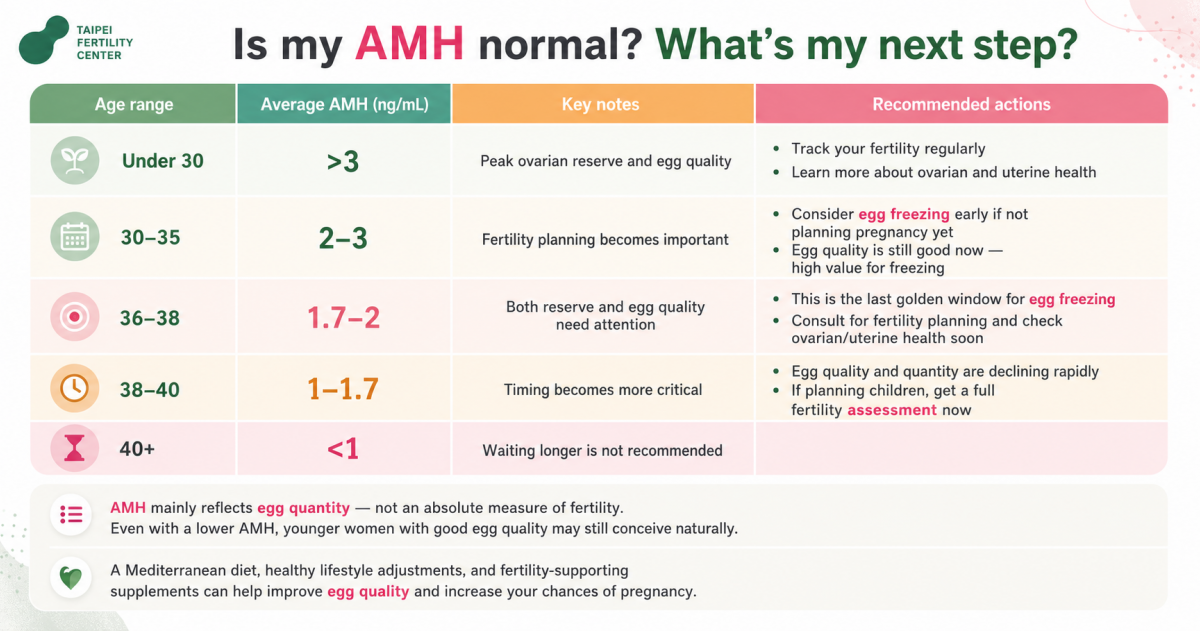
Check Your AMH Level
Every woman's ovarian reserve declines at a different rate — so chronological age alone doesn't tell the full story. The key indicator used to assess fertility potential is AMH (Anti-Müllerian Hormone). With a simple blood test, you can get an accurate picture of your current ovarian reserve.
Part 3: The Complete Egg Freezing Process
The entire egg freezing cycle typically takes about 2 to 3 weeks and includes four key stages: initial evaluation, ovarian stimulation, follicle monitoring, and egg retrieval and freezing. Throughout the process, you'll generally need 3 to 4 clinic visits, depending on your physician's assessment.
-
Initial Evaluation — Before starting your cycle, your doctor will order blood tests to assess ovarian function, including AMH (ovarian reserve) and FSH (follicle-stimulating hormone), along with a gynecological ultrasound.
-
Ovarian Stimulation — Starting on day 1–3 of your menstrual cycle, you'll begin daily hormone injections to stimulate your ovaries to produce multiple eggs. Blood tests and ultrasounds are used throughout this stage to monitor your response.
-
Follicle Monitoring — Around day 6–10 of your cycle, you'll return for a follow-up visit so your doctor can track follicle maturity via ultrasound and determine the optimal timing for egg retrieval.
-
Egg Retrieval and Freezing — After a trigger shot, the egg retrieval procedure is performed 34–36 hours later. The retrieved eggs are then immediately frozen and stored in liquid nitrogen at -196°C (-321°F) for future use.
Part 4: Do I Need to Be Hospitalized for Egg Freezing? What Should I Watch for Afterward?
The Procedure and Its Impact on Daily Life
Egg freezing does not require hospitalization — you can go home the same day as your egg retrieval procedure. Afterward, you may experience mild bloating, slight spotting, or a temporarily irregular period due to the hormone medications. These are all normal, expected reactions, and they typically resolve within 1 to 2 months. During this time, simply maintain a balanced diet and avoid strenuous exercise.
Effect on Ovarian Reserve and Body Changes
Egg retrieval does not deplete your ovarian reserve or cause early menopause. This is because the cycle only recruits and retrieves follicles that would naturally be lost that month anyway — it has no impact on your long-term egg supply. As for the common concern about "weight gain," this is actually temporary water retention caused by hormonal fluctuations, and it resolves naturally once your cycle returns to normal.
Part 5: Is There a Storage Time Limit for Frozen Eggs?
Under Taiwan's Assisted Reproduction Act, frozen eggs can be stored for a base period of 10 years. If you wish to continue storing your eggs beyond that point, you can extend the storage period with your written consent (as the egg provider), for as long as you specify.
While eggs themselves can remain frozen — and essentially "ageless" — for many years, we still recommend planning to complete your family-building goals before age 45, in order to reduce the potential risks and complications associated with pregnancy at an advanced age.
Part 6: How Much Does Egg Freezing Cost? Are There Any Subsidies?
The egg retrieval and freezing procedure itself costs approximately NT$60,000–80,000 (roughly US$1,900–2,500), not including medication. Medication costs vary based on individual response, so the total typically starts at around NT$120,000 (roughly US$3,800). After that, an annual egg storage fee of approximately NT$10,000 (roughly US$315) applies.
As for government subsidies: elective (social) egg freezing alone is currently not covered under Taiwan's central government subsidy program. However, under Taiwan's assisted reproduction subsidy policy, if egg freezing is required for medical reasons (such as before chemotherapy) and the couple meets the eligibility criteria for IVF subsidies, the related costs for that treatment cycle — including sperm retrieval, fertilization, embryo culture, and embryo transfer — may be eligible for subsidy support.
Part 7: How Do You Get Pregnant After Freezing Your Eggs? Does Egg Freezing Affect Future Pregnancy Rates?
Freezing your eggs doesn't mean you're committed to using them. If you currently have normal ovulation and a stable partner, you can still try to conceive naturally first — and if that succeeds, your frozen eggs simply remain in reserve as a backup for the future.
One important point worth clarifying: the length of storage time does not affect pregnancy success rates. Because vitrification preserves eggs in exactly the physiological state they were in at the moment of freezing, as long as the eggs were healthy when frozen, they retain a high fertilization potential and pregnancy rate even after many years in storage. If you decide to use your frozen eggs in the future, they'll go through an IVF cycle — thawing, fertilization via ICSI (intracytoplasmic sperm injection), and embryo transfer — to complete the journey toward pregnancy.
Part 8: Frequently Asked Questions (FAQ)
Q: What's the best age for egg freezing? Am I a good candidate?
A: A woman's optimal fertility window is between 25 and 35 years old, and we recommend freezing your eggs between ages 30 and 35, when egg quality and quantity are still relatively stable — making this the most cost-effective window. Good candidates include those pursuing elective (social) egg freezing (focused on career goals or haven't yet found a partner) and those pursuing medical egg freezing to preserve fertility before cancer treatment or due to severe gynecological conditions such as ovarian (chocolate) cysts.
Q: Does the egg freezing process require hospitalization? Are there any side effects?
A: No hospitalization is needed — you can go home the same day as your egg retrieval. You may experience brief bloating or light spotting afterward, which typically resolves within 1 to 2 months. Egg retrieval only recovers follicles that would naturally be lost that month, so it does not deplete your ovarian reserve or cause early menopause. The "weight gain" sometimes mentioned online is usually temporary water retention from the medication, which subsides once your hormones return to normal.
Q: Is there a storage time limit for frozen eggs?
A: Under Taiwan's Assisted Reproduction Act, eggs can be stored for a base period of 10 years. If you need to extend storage beyond that, you can do so with your written consent. While the eggs themselves can remain frozen indefinitely without aging, we still recommend completing your family-building plans before age 45, to help support a healthy pregnancy for both mother and baby.
Q: How much does egg freezing cost? Is there government funding available?
A: The total cost is approximately NT$120,000 (roughly US$3,800), covering both the procedure and medication (which varies by individual response), plus an annual storage fee of about NT$10,000 (roughly US$315) afterward. Regarding subsidies: Taiwan's central government primarily offers funding for medical fertility preservation (such as for cancer patients, up to NT$70,000). Subsidies for elective (social) egg freezing vary by city/county government and are subject to each local health department's latest eligibility rules and funding caps. (Note: these government subsidy programs are designed for Taiwanese residents/national health insurance holders — international patients are generally not eligible.)
Q: What tests are needed before egg freezing?
A: The most important indicator is your AMH (Anti-Müllerian Hormone) level, which can be measured with a simple blood test to assess your current ovarian reserve. Before starting your cycle, we recommend an AMH test, an FSH (follicle-stimulating hormone) check, and a gynecological ultrasound, so your doctor can design the most precise stimulation protocol for you.
Q: If I decide to get pregnant after freezing my eggs, do I have to use them? Does storage length affect pregnancy rates?
A: Not necessarily. If you have normal ovulation and a stable partner after freezing your eggs, you can still try to conceive naturally first. If you do need to use your frozen eggs later on, they'll go through an IVF cycle for thawing and fertilization. Storage length itself doesn't affect pregnancy rates — as long as the eggs were of good quality when frozen, vitrification technology allows them to maintain excellent fertilization potential and pregnancy success rates even after many years in storage.
Part 9: Why Choose TFC Taipei Fertility Center for Egg Freezing?
TFC Taipei Fertility Center is one of Asia's leading flagship reproductive centers, led by an expert medical team headed by Taiwan's renowned "Father of IVF." We provide complete, one-stop egg freezing services — from initial consultation and bloodwork, to egg retrieval, freezing, and post-procedure care — supported by state-of-the-art laboratory facilities and equipment to ensure your eggs are stored safely and securely, giving you complete peace of mind.
TFC also offers a range of supporting services, including Traditional Chinese Medicine, psychological counseling, and nutrition counseling, along with a dedicated patient app and a comfortable waiting environment — all designed to ease the stress and anxiety that can come with treatment, so every patient can feel supported as they prepare for the happy news ahead.
