












More and more women are choosing to become mothers on their own, even without a partner. “Can I raise a child well by myself?” is a question that is increasingly becoming a real life option for many. This choice is known as being a single parent by choice, a family path that has gained visibility in recent years. It isn’t the result of losing a partner or an unplanned pregnancy, but a path taken deliberately after careful, rational consideration.
This article begins with the story of Cindy, a Silicon Valley tech professional, and introduces what it means to be a single parent by choice and how it differs from traditional single parenthood. It also looks at why this path has become more common in recent years, and how egg freezing and assisted reproduction in Taiwan can help you keep more options open for your family planning.
What Is a Single Parent by Choice? A New Kind of Family, Through Cindy’s Story
A single parent by choice (SPBC, also known as a single mother by choice, or SMC) is a person who, while single, deliberately plans for the psychological, financial and social support needs and the wellbeing of a child, and then chooses to become a parent. Most build their families through legal assisted reproduction or adoption.
Cindy, author of 志願單親:不需誰來完整我,矽谷科技人的單身生養實踐 (Single Parent by Choice: You Don’t Need Anyone to Complete You, a Silicon Valley Tech Professional’s Journey to Solo Parenthood), is one example. After working in Silicon Valley for many years, she met a single mother by choice at a brunch gathering. This woman had not become a single parent through divorce or the death of a spouse, but had chosen to have a child on her own. The encounter made Cindy realize that becoming a mother doesn’t have to wait for a partner.
Inspired by this idea, she began to rethink her life plans. In 2020, she used donor sperm and IVF treatment to have her daughter and start her own family. She later wrote about her experience in a book, so that more women can see that there are other ways to have a child beyond traditional marriage.
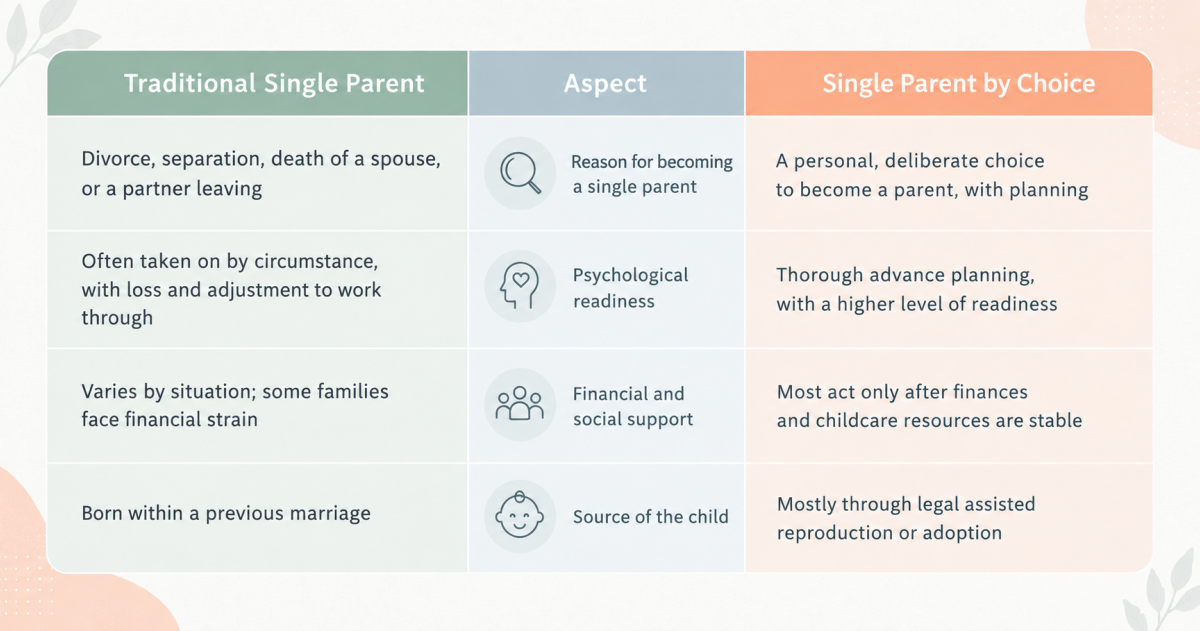
▍How It Differs from Traditional Single Parenthood
Why Is Single Parenthood by Choice on the Rise? Motivations and Who Is Choosing It
Single parenthood by choice has drawn growing attention in recent years, closely tied to changes in social structures and shifting values. As family forms are no longer limited to traditional marriage, more people are rethinking their options for life and parenthood. Below are the most common motivations and the main groups of people who choose this path.
Why people choose to become single parents by choice
-
Fertility timeline and health planning: After the age of 35, women face declining ovarian function and a higher risk of chromosomal abnormalities. Some choose to plan ahead for fertility so they don’t miss their window by waiting.
-
Shifting values: From the legalization of same-sex marriage to DINK couples and co-parenting, a wide range of family forms are gaining social acceptance. Wanting to become a parent without a partner is no longer seen as a rare choice.
-
Relationship choices and psychological autonomy: Some women are not against intimate relationships, but they don’t want to have a child within a relationship that isn’t right for them. Rather than entering an unstable marriage and exposing a child to conflict and risk, they find that building a family on their own better matches what they want for their lives and for raising a child.
Who tends to choose this path
Single parents by choice tend to share a fairly clear profile: mostly women with a certain level of stability in their lives and finances.
-
Unmarried women aged 30–45: Their careers are becoming established, but they are still looking for a partner, and they have started to take their fertility timeline and life plans seriously.
-
Career-focused women: They have achieved a certain level of success in their field and don’t want marriage to disrupt their career momentum, so they choose to address family planning first.
-
Financially independent women: They have a stable income and the ability to plan finances, and can cover the long-term costs of child-rearing, housing and daily life.
-
Women with family or a support network: Parents, siblings or friends can help out, which gives them more flexibility and support in day-to-day parenting and life arrangements.
Read more:
Egg Freezing Subsidy 2026: How Much Does Egg Freezing Cost? A Complete Guide to Subsidy Eligibility by City and County
How Do You Get Pregnant After Egg Freezing? 5 Key Steps from Thawing to Embryo Transfer, Explained by Our Doctor
How to Become a Single Parent by Choice: Assisted Reproduction and Adoption
In Taiwan, single parents by choice mainly build their families through assisted reproduction or adoption. Both routes are regulated by law, so it’s important to understand the current rules and what is actually feasible before you start planning.
Assisted reproduction (sperm banks and IVF)
Under Taiwan’s current Assisted Reproduction Act, assisted reproductive technology is available only to heterosexual married couples with infertility. Even if a single woman has already frozen her eggs, she currently cannot undergo intrauterine insemination (IUI) or in vitro fertilization (IVF) in Taiwan as a single person. The system is moving toward change, however. On December 11, 2025, the Executive Yuan approved a draft amendment that would expand eligibility to infertile heterosexual couples, legally married female same-sex couples, and single women.
As of May 2026, the draft was still under review in the Legislative Yuan, and no date has been announced for when it would take effect. If you are planning around this, we recommend checking the Ministry of Health and Welfare website for the latest status before making a decision. Until the law changes, some women who wish to become single parents by choice pursue assisted reproduction overseas, for example in the United States or Southeast Asia, following the local regulations.
TFC would like to remind you that seeking fertility treatment abroad comes with risks, including language barriers, difficulty seeking compensation in the event of a medical dispute, risks in how biological samples are managed, and unequal access to information. You may even become a target for illegal agents. Asking a male friend to donate sperm privately is also not permitted under current law, and it cannot ensure health screening of the donor, clarity on parental rights, or the child’s right to know their origins. If you are considering treatment abroad, we recommend consulting a licensed fertility center in Taiwan first. A professional evaluation can help you find an appropriate route and protect yourself along the way.
Adoption
Under Articles 1072 to 1083 of the Family section of Taiwan’s Civil Code, single people can apply to adopt, but the adoption must be approved by the court, and the applicant must complete the evaluation, matching and home visit procedures run by social welfare authorities. In its review, the court considers the adopter’s age, health and financial capacity, as well as whether their overall living environment is suitable for raising a child. If you are thinking about adoption, we recommend consulting the Social and Family Affairs Administration under the Ministry of Health and Welfare, or a licensed adoption placement agency, first.
Planning Ahead: Keep Your Options Open for the Future
If you’re still thinking about whether to become a single parent by choice, the most concrete first step that current regulations allow is freezing your eggs. Egg freezing doesn’t mean you have to go down the single-parent path. It simply keeps your options open for later. Even if your relationships, career and family plans are still changing, you can still hold on to the possibility of becoming a mother.
Physiologically, egg quality declines significantly after age 35, and the rate of chromosomal abnormalities rises with age. This is why ages 30 to 35 are generally considered a more suitable window for egg freezing. By freezing your eggs, you can put the decision about having children on hold and wait for a better moment, such as when the law changes, when a partner comes along, or when you feel ready.
If you’d like to plan further, you can add the official Taipei Fertility Center (TFC) LINE account to book a professional assessment. It can help you understand your ovarian reserve and overall fertility, so you can arrange egg freezing or other treatment based on your own needs. Knowing where you stand now can help you keep more fertility options open at every stage of life.
Read more:
What Is IVF? A Complete Guide to IVF Success Rates, Process, Costs and Subsidies