













Many couples has been stuggling with Infertility, but the bright side is that as reproductive technology evolves, infertility is no longer a dead end. IUI is frequently mentioned in fertility treatments.Some FAQs like what exactly is IUI? How much does it cost? What are the pros and cons? Let TFC address your query.
What is IUI? And any difference vs. IVF?
In infertility treatments, IUI and IVF are the most common ones. We’ll introduce what IUI and IVF is, and the differences between the two, so that you shall have a more clear idea of assisted reproduction.
IUI (Intrauterine Insemination)
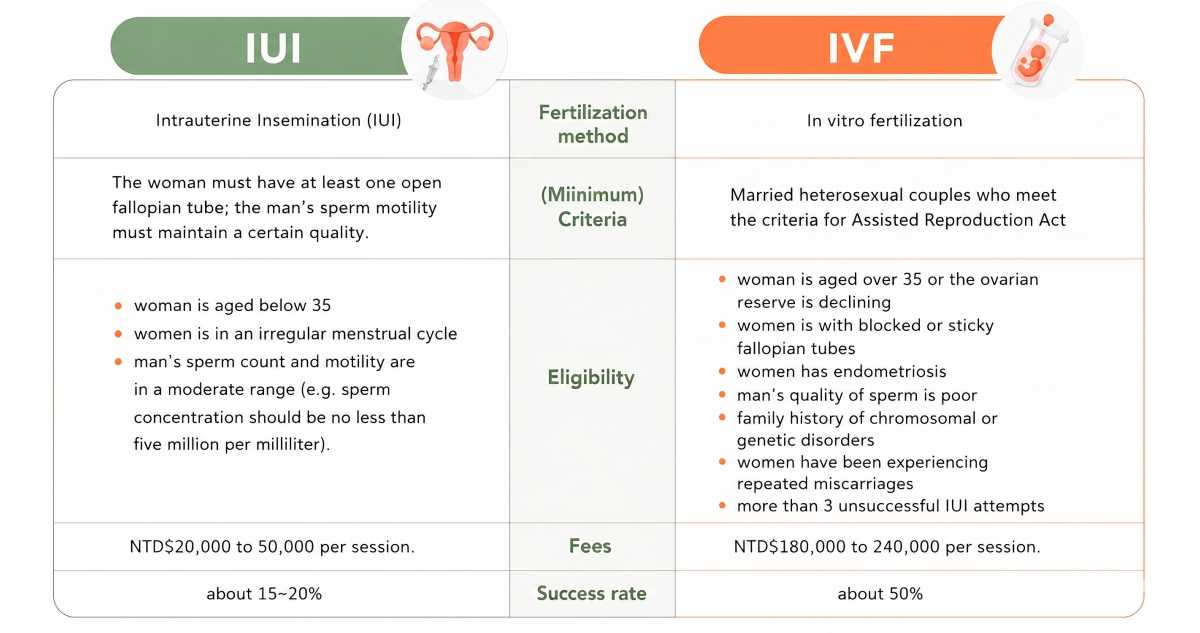
IUI which stands for intrauterine insemination, is to process a semen sample on the day of ovulation to purify and select sperm with good quality and motility. The selected sperm are then concentrated in a special culture medium. Using a dedicate insemination catheter, the prepared sperm are carefully injected into the woman’s uterine cavity.
Since fertilization for most cases occurs in the fallopian tubes, a key prerequisite for IUI is that the woman's fallopian tubes must be unobstructed. If infertility results from blocked fallopian tubes, IUI is not a viable option. Compared to in vitro fertilization (IVF), IUI is much more affordable, costing around NT$20,000 to NT$50,000 per session
IUI fits for couples who live apart, women with irregular menstrual cycles, or cases where the male partner’s sperm count and motility are below normal but not severely impaired.

In Vitro Fertilization (IVF)
IVF, or in vitro fertilization, involves retrieving eggs and sperm through specialized medical procedures and fertilizing them in a laboratory . Once the embryos are matured and in good condition, they are then transferred into the woman’s uterus to continue developing and complete the pregnancy process.
Although IVF may seem similar to IUI in terms of procedure, the key difference is that IVF involves implanting embryos, not just sperm.
Since IVF takes multiple steps—such as egg retrieval surgery, embryo cultivation in the laboratory, and embryo transfer—the cost is significantly higher. One session typically costs between NT$180,000 and NT$240,000.
Yet, IVF fits for more different infertility cases, such as women over 35 or those with diminished ovarian reserve, women with blocked fallopian tubes on both sides, those who have experienced recurrent miscarriages, and men with poor sperm quality.
Read more:
- IUI or IVF? What’s the Difference? Everything You Need to Know to Choose the right assisted reproductive method
- Curious about IUI? – TFC is the go-to-place renowned for high success rate and comprehensive precision medical care.
What are the downsides of IUI? full list of the Pros and Cons!
Artificial insemination is less expensive, less invasive, and can be an effective option for individuals facing infertility. So why isn’t it suitable for everyone? What are the drawbacks of artificial insemination, and in what situations is it the right choice?
the highest rated advantages of IUI:
lower cost: One session may cost around NT$20,000 to NT$50,000, making it much more affordable than IVF.
simpler procedure: Unlike IVF, which requires egg retrieval and embryo cultivation and often takes 3 to 6 months per session, IUI is rather straightforward. It does not involve surgery—semen is simply injected into the uterus. If all conditions are favorable and everything goes smoothly, a session can be completed in just one month.
Major downside of IUI is
-
narrower range of patient: prerequisite for IUI is: at least one of the woman’s fallopian tubes must be unobstructed. And sperm count and motility must be in a considerable range, which indicating the issues IUI can address is relatively limited.
-
age restrictions: IUI is generally recommended for women under the age of 35. For women over 35, IVF is usually the preferred treatment due to higher success rates.
-
lower success rate: On average, the success rate for IUI is around 15–20%, while IVF is approximately 50%, indicating better effectiveness in general.

Net, whether a mother shall go for IUI or IVF depending on the examination results and her physical condition. Working with an experienced reproductive medical team is highly recommended as they can provide a comprehensive assessment and offer personalized assisted reproductive treatment plans, making the journey to parenthood smoother.
How much does IUI cost? Everything need-to-know about IUI (artificial insemination)—answered!
Now that you've been reading this and learned about various aspects of IUI, you may still have questions. Based on TFC’s comprehensive clinical experience, we understand your concerns—so let us answer them one by one!
How much does (IUI artificial insemination cost)?
The average cost for one IUI treatment is approximately NT$20,000 to NT$50,000.
The treatment shall cover:
-
Ovulation stimulation injections
-
Medications
-
Sperm processing
-
Ultrasound examinations
-
Blood hormone tests
-
Insemination procedure fees
Actual cost shall vary depending on each patient’s personalized treatment plan and thus always consulting your medical professionals.

Q: Can you choose the baby’s sex through IUI?
According to Article 16, Item 3 of the Artificial Reproduction Act, sex selection is not allowed during artificial reproduction—unless both spouses carry sex-linked genetic diseases, such as:
-
Hemophilia
-
Color blindness
-
Spinal muscular atrophy (SMA)
In such cases, PGT-A (Preimplantation Genetic Testing for Aneuploidy) may be used to identify the embryo’s sex, in order to prevent or reduce the risk of passing on hereditary diseases.

Q. Anything I shall know about IUI?
The quality of the eggs and sperm is very important for IUI. The husband should abstain
from sexual activity for 3-5 days before sperm collection, but not exceed one week.
In addition, whether before or after IUI, it is recommended to keep a healthy lifestyle, have a balanced and varied diet, avoid stress, and be in a positive mood. Furthermore, after the sperm is implanted into the uterus, the patient should avoid hot baths, hot springs, and vigorous exercise. It is also important to follow the doctor's instructions to have some in-take of progesterone, which helps the embryo successfully implanted.
Few patients may develop Ovarian Hyperstimulation Syndrome (OHSS) due to ovulation-inducing medications. The symptoms may include abdominal discomfort, bloating, nausea, or vomiting.
If you experience severe abdominal pain or persistent vomiting, it is strongly recommended to seek medical professionals’ help as soon as possible..
In very rare cases, after sperm insemination, some individuals may develop pelvic infections or bleeding. If you develop a fever or severe abdominal pain, seek immediate medical assistance to ensure your health and safety.
Q: When is the best time for IUI artificial insemination?
For women experiencing infertility, it is recommended to kick start IUI related evaluation and the treatment before she trunks to 40.
When a woman is aged over 40, it is generally advised to consider in vitro fertilization (IVF) directly given a higher success rate.
Q: Is the eligibility of IUI treatment only limited to married couples?
Yes. According to Taiwan’s Artificial Reproduction Act, only heterosexual married couples are eligible to receive IUI (artificial insemination) treatments.
Q: Who is entitled for the financial subsidies for IUI (artificial insemination) treatment?
Although both IVF (in vitro fertilization) and IUI (artificial insemination) are all part of assisted reproductive treatments, currently only IVF treatments are eligible for government subsidies provided by the Ministry of Health and Welfare. IUI (artificial insemination) is not covered for now.
Q: What if my IUI attempts remain disappointful (unsuccessful)?
IUI success rate is on average 15–20% per treatment. Upon a disappointing attempt, it’s recommended to take a 1–2 month break before another one..
However, if IUI (artificial insemination) treatment has been failing for more than 3 times, suggest discussing with your doctor when to switch to IVF. IVF generally offers a higher success rate and can address a wider range of infertility issues.
Partner with TFC Taipei Fertility Center for IUI (Artificial Insemination) — enjoy the professional, high-quality care!
TFC Taipei Fertility Center is a flagship reproductive clinic in Asia and the sole clinic in Taiwan certified with the SNQ (Symbol of National Quality) mark. With a team of highly experienced physicians — many with over 20 years of clinical expertise — and skilled medical staff, TFC offers comprehensive care that includes:
TFC is not only renowned in Taiwan, but trusted by numerous overseas patients, seeking specialized fertility treatment.
Generally, although the success rate of IUI is around 20%, the success rate at TFC's medical team is as high as 33%! Additionally, the IUI process is relatively simple, with low costs, minimal pain, and no need for anesthesia. It is currently the only non-invasive treatment that can increase pregnancy rates, significantly reducing the financial burden and mental stress during the pre-pregnancy process.
If you have any other concerns about IUI or any aspects of the treatment, feel free to contact TFC Taipei Fertility Center. Let us accompany you with sincere and warm support as you walk the journey toward parenthood!