













Health is an essential part of every woman's life, and gynecologic conditions in particular can affect both physical and mental well-being. "Chocolate cyst" is a common but confusing term. Many women have never had a gynecologic exam and may not realize they are already affected. What exactly is a chocolate cyst? Why does it develop? And how can it affect your health? This article takes a closer look at the causes, symptoms, and treatment options of chocolate cysts so you can better understand your own health.
What Is a Chocolate Cyst? How Does It Differ from a Uterine Fibroid?
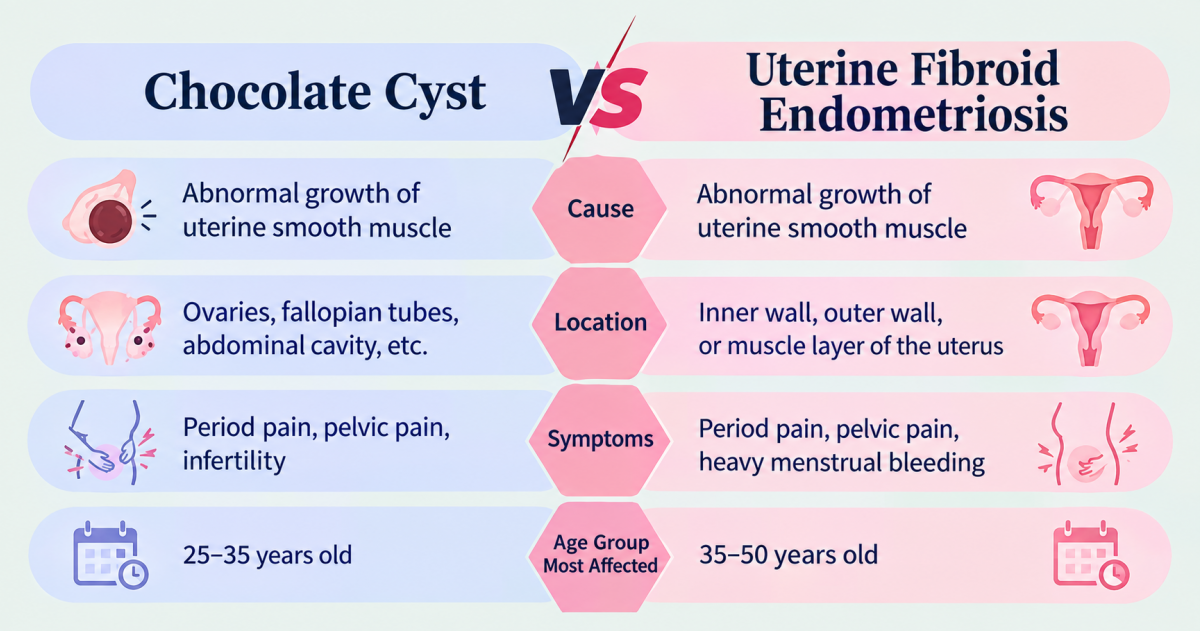
Chocolate cysts are often confused with uterine fibroids. Although both affect women's health and daily life, they differ in cause, location, and symptoms. The differences are explained in detail below:
The key difference lies in where the condition occurs and how it develops:
- A chocolate cyst is a form of ovarian endometriosis (ovarian endometrioma), in which endometrial-like tissue grows outside the uterus and forms a blood-filled cyst on the ovary.
- A uterine fibroid is a benign smooth-muscle tumor that grows in or on the wall of the uterus (myometrium) and is not directly related to endometrial tissue outside the uterus.
Chocolate Cyst (Ovarian Endometrioma)
A chocolate cyst forms when endometriosis affects the ovary. During the menstrual cycle, the displaced endometrial tissue still responds to hormones by thickening and shedding. However, because it lies outside the uterine cavity, the blood cannot leave the body through normal menstruation and instead builds up outside the uterus. Endometriosis most commonly occurs in both ovaries. When blood repeatedly collects in the ovary with no way out, it gradually turns into a thick, dark-brown fluid resembling chocolate, which is how the "chocolate cyst" got its name.
- Who is most affected: Endometriosis can develop in girls of any age during adolescence, even before puberty. Around two-thirds of adult patients with endometriosis begin to experience symptoms such as period pain before the age of 20.
- Main symptoms: Period pain, pelvic pain and, in severe cases, effects on ovarian function and fertility that may lower the chance of natural conception.
Uterine Fibroid
Uterine fibroids are benign tumors that form when smooth-muscle cells of the uterus grow abnormally (also called myomas or fibroids). They may occur beneath the uterine lining, within the muscle layer, or beneath the outer surface of the uterus. The exact cause is not yet fully understood, but genetics, hormonal imbalance, and environmental factors may play a role.
- Who is most affected: Uterine fibroids are the most common benign tumors in women and are seen mainly in women of reproductive age. Studies show that both incidence and prevalence rise with age among reproductive-aged women.
- Main symptoms: Most uterine fibroids are small and cause no symptoms. When symptoms do occur, they depend on the number, size, and location of the fibroids and fall into three main categories:
- Heavy or prolonged menstrual bleeding
- Pelvic pressure or pain
- Reproductive problems (such as infertility, miscarriage, or obstetric complications)
What Causes Chocolate Cysts? Common Symptoms at a Glance
The exact cause is not yet fully understood, and no single explanation has been confirmed. Multiple theories may work together to lead to endometriosis:
-
Retrograde menstruation: Some endometrial cells flow backward through the fallopian tubes into the abdominal cavity, where they implant and grow on the ovaries.
-
Immune dysfunction: The immune system fails to recognize and clear ectopic endometrial cells, allowing them to survive and grow in areas such as the ovaries.
-
Genetic factors: Women with a family history of endometriosis have a higher risk of developing chocolate cysts.
-
Spread through blood and lymph: Endometrial cells may travel through the bloodstream or lymphatic system to the ovaries and form lesions. Another theory suggests that a newborn's uterus, influenced by maternal hormones, may bleed in reverse and give rise to early lesions.
In the early stages, chocolate cysts may cause no obvious symptoms. As the condition progresses, the following may occur:
-
Worsening period pain: Lower abdominal pain that may last throughout the period and interfere with daily life.
-
Pain during sex: If the cyst pulls on or presses against the uterine ligaments or vaginal wall, sex may be painful.
-
Chronic pelvic pain: Some patients feel persistent pelvic or lower abdominal pain even outside of their period.
-
Urinary or bowel symptoms: If the cyst presses on the bladder or intestines, it may cause frequent urination or difficulty urinating or passing stools.
-
Infertility: About 30–50% of women with chocolate cysts also have infertility, especially those with significant period pain and chronic pelvic pain. Endometriotic lesions cause chronic inflammation and release inflammatory mediators that may affect the quality and survival of eggs, sperm, and embryos.
-
Cyst rupture: A blow to the cyst (such as from vigorous exercise or sex) may cause it to rupture, leading to severe abdominal pain, nausea, vomiting, and vaginal bleeding. In severe cases it can cause peritonitis, so seek medical care immediately.
How Are Chocolate Cysts Diagnosed? The 3 Main Methods
Early diagnosis of chocolate cysts is very important for later treatment and fertility planning. Three methods are commonly used in clinical practice:
1. Pelvic Examination
A pelvic examination is the basic gynecologic check. The doctor feels (palpates) the pelvic area to look for abnormalities. The doctor checks the position and size of the uterus and ovaries, and a larger cyst may show up as an enlarged ovary or an abnormal mass. A pelvic exam can also help the doctor tell whether a cyst is pressing on nearby organs, including the bladder and small intestine. However, its accuracy is limited, and smaller or deeper lesions may be missed. An ultrasound is therefore still needed to confirm the diagnosis.
2. Ultrasound
Ultrasound is the most commonly used non-invasive imaging test and gives real-time images of the ovaries and pelvis. The doctor may use a transvaginal or abdominal ultrasound to assess the size, location, and internal structure of the cyst. Chocolate cysts usually appear on ultrasound with low-level internal echoes, often described as a "ground-glass" pattern, which helps distinguish them from other ovarian cysts, such as corpus luteum cysts, or from ovarian tumors. Sometimes, however, ultrasound alone cannot confirm the diagnosis with complete certainty, and further testing may be needed.
3. Blood Test
CA-125 levels may be elevated in patients with endometriosis. However, serum CA-125 is usually not tested routinely when evaluating or treating endometriosis, because other conditions, especially ovarian cancer, can also raise it. CA-125 alone is not enough to confirm a chocolate cyst. Doctors still need to combine imaging results with the patient's symptoms for a more accurate diagnosis.
If the methods above cannot confirm the diagnosis, or if the condition is suspected to be more severe, the doctor may recommend more advanced tests:
Magnetic Resonance Imaging (MRI)
MRI is a high-resolution imaging test that provides more precise details of the lesions, helping doctors assess the characteristics and distribution of chocolate cysts. With MRI, the proportion of adnexal lesions that remain indeterminate after ultrasound can be reduced from about 20-25% to 5-7%.
Laparoscopy
Laparoscopy is currently the most accurate diagnostic method for chocolate cysts. Through minimally invasive surgery, the doctor can directly view the lesions inside the pelvic and abdominal cavity to confirm the form and distribution of the chocolate cysts, and can take tissue samples for pathology testing at the same time. It not only allows an accurate diagnosis but also helps assess the severity of endometriosis, and treatment can even be carried out during the procedure, such as removing lesions or cysts.
Which Groups Are at High Risk for Chocolate Cysts? Who Should Pay Attention
Not all women share the same risk of developing chocolate cysts. Certain physical characteristics or lifestyle habits may raise the chance. The following groups of women should pay particular attention:
1. Women Who Have Never Been Pregnant
Women who have never been pregnant, especially those of reproductive age, have a higher risk of chocolate cysts. This is because ovulation does not occur and there are no periods during pregnancy, which lowers the chance of developing chocolate cysts. Conversely, with long-term regular ovulation, the chance of menstrual blood flowing backward into the abdominal cavity increases.
2. Women with Early Menarche or Late Menopause
For women whose first period came before age 11, the menstrual cycle starts earlier, so their lifetime exposure to endogenous estrogen may be longer. Retrograde menstruation also becomes more likely, which raises the chance of developing chocolate cysts. The same applies to women who reach menopause later.
3. Women with a Family History of Endometriosis
Women whose mother or other first-degree female relatives have been diagnosed with endometriosis also have a higher risk of developing chocolate cysts.
4. Women with Abnormal Menstrual Cycles
Women with short menstrual cycles (less than 27 days) or periods lasting more than 7 days are more prone to retrograde menstruation into the abdominal cavity, which increases the chance of endometriosis.
5. Women with Autoimmune Diseases
Women with autoimmune conditions such as systemic lupus erythematosus or rheumatoid arthritis may face a higher risk, because the immune system cannot effectively clear ectopic endometrial tissue.
6. Women Frequently Exposed to Environmental Hormones
Plasticizers such as bisphenol A (BPA) and other environmental hormones (endocrine-disrupting chemicals), such as dioxins and polychlorinated biphenyls (PCBs), are considered risk factors for endometriosis. These compounds may alter estrogen metabolism and suppress the immune system, weakening the body's ability to clear ectopic endometrial tissue.
7. Women with Congenital Reproductive Tract Abnormalities
Congenital reproductive tract abnormalities, such as uterine malformations or vaginal atresia, may prevent menstrual blood from leaving the body normally and increase the chance of it flowing backward into the pelvic cavity, which raises the risk of chocolate cysts. Such conditions can usually be found through a gynecologic exam, so they can be addressed early to reduce potential health risks.
Can You Get Pregnant with a Chocolate Cyst? Common Questions Answered
Many women worry about their fertility after being diagnosed with a chocolate cyst and have questions such as: Can I get pregnant naturally? Will the cyst go away on its own? Do I need surgery? Below, we go through these common questions one by one to help you better understand how chocolate cysts may affect you and how to respond.
Q1: Can You Get Pregnant with a Chocolate Cyst?
Yes, it is possible, but it depends on the size and location of the cyst and other factors related to reproductive health. The effect of a chocolate cyst on fertility mainly depends on whether it damages ovarian function or blocks the fallopian tubes. Here is how it may play out in different situations:
- Small cysts (less than 5 cm): A small cyst has less effect on the ovary, and natural pregnancy may still be possible. However, a cyst may grow over time, so regular follow-up is recommended to make sure reproductive function is not affected.
- Medium to large cysts (5 cm or more): Larger cysts may affect ovarian function and can even cause adhesions between the ovaries and fallopian tubes, which lowers the chance of natural conception. Patients in this situation usually need treatment first before trying to conceive.
- The best window after surgery: After a laparoscopic operation to remove the cyst, the three to six months that follow are generally considered the best window for conceiving, when the chance of pregnancy may be higher. Actively trying to conceive during this period is therefore recommended.
Q2: Can a Chocolate Cyst Shrink?
In some cases, a chocolate cyst may shrink, but most still need appropriate treatment and follow-up.
- During pregnancy: Because estrogen levels drop during pregnancy, a chocolate cyst may shrink on its own, and may even be partially absorbed.
- After menopause: After menopause, periods stop and the growth of endometriosis tissue is suppressed, so the cyst usually shrinks gradually.
- With medication: Oral contraceptives, progestins, or other ovulation-suppressing medications can slow the growth of a chocolate cyst and may make it shrink slightly.
It is important to note that even if a cyst shrinks, it may still come back because of residual lesions. Patients are therefore advised to keep up regular follow-up to make sure the condition stays stable, and to receive treatment when necessary.
Q3: Will a Chocolate Cyst Go Away?
A chocolate cyst will not go away on its own. Even with medication, treatment can only suppress the growth of the cyst and reduce symptoms; it cannot completely remove a cyst that has already formed. Patients should therefore have regular follow-ups and discuss a suitable treatment plan with their doctor. If the cyst is large and cannot be controlled with medication, surgical removal may need to be considered to avoid further effects on ovarian function or fertility.
Q4: How Are Chocolate Cysts Treated? Is Surgery Needed?
Treatment for chocolate cysts mainly depends on the size of the cyst, the severity of symptoms, and the patient's plans for having children. Doctors usually recommend a suitable treatment based on the following situations:
- Cysts smaller than 5 cm with no noticeable symptoms: These can generally be treated with medication, such as pain relievers, oral contraceptives, progestins, or GnRH (gonadotropin-releasing hormone) medications, which help suppress the growth of the endometrium, reduce period pain, and control the growth of the cyst.
- Cysts 5 cm or larger, or affecting quality of life: If a patient has severe period pain, infertility, or affected ovarian function, laparoscopic cystectomy (removal of the cyst) may be considered as the first-line treatment. Its advantages are that it can reduce the risk of ovarian torsion or rupture and improve symptoms. Its drawback is that ovarian reserve may be affected. Because removing the cyst may affect ovarian function, such as by reducing egg reserve, women who plan to have children are advised to discuss with their doctor whether to undergo egg freezing before surgery to preserve fertility.
Q5: What Should You Watch Out for in Your Diet with a Chocolate Cyst?
A diet that is low in estrogen, high in fiber, low in fat, and high in antioxidants is recommended. Recommended foods include:
- Antioxidant-rich foods: Berries, leafy green vegetables, and nuts may help reduce oxidative stress and inflammation in the body.
- Foods rich in omega-3 fatty acids: Such as salmon, flaxseeds, and walnuts. They may help reduce inflammation and maintain hormonal balance.
- High-fiber foods: Brown rice, whole grains, and oats can help the body clear excess estrogen and keep the endocrine system stable.
Some foods may worsen inflammation or affect estrogen metabolism, so it is advisable to eat less of them:
- High-fat and fried foods: These may increase inflammation in the body and worsen symptoms.
- Refined, high-sugar foods: Such as desserts and sugary drinks, which may affect insulin and hormonal balance.
- Foods rich in animal- and plant-derived estrogens: Crab roe, royal jelly, and soy isoflavones may promote the growth of endometriosis tissue.
- Tonic foods: Some blood-nourishing ingredients (such as Si Wu Tang, or Four-Substance Decoction, and ginseng) may make ectopic endometrial cells more active, so excessive intake should be avoided.
- Raw, cold, or "heaty" foods: Such as grapefruit, fried peanuts, and spicy foods. These may affect blood circulation or trigger abnormal growth of the endometrium.
Q6: How Can You Manage Chocolate Cysts?
Keeping good lifestyle habits may help lower your risk of developing chocolate cysts: avoid staying up late, drinking too much alcohol, and exposure to environmental hormones, and get moderate exercise.
Early Detection, Effective Treatment: Let TFC Taipei Fertility Center Walk with You
Chocolate cysts may affect women's health and fertility, and early detection and treatment are key. TFC Taipei Fertility Center has a professional medical team and advanced technology, and can provide accurate diagnosis and personalized treatment plans for every patient. Whether treatment involves medication or surgery, it can be tailored to each person's needs to support the best possible outcomes.
For women who plan to have children, TFC's physician team offers tailored strategies to help you conceive. Through postoperative care and regular follow-up, we work to lower the risk of cyst recurrence and support your reproductive health.
If you are dealing with a chocolate cyst or fertility concerns, we welcome you to contact TFC Taipei Fertility Center. Let us accompany you with professionalism and patience toward a healthy and happy life.