













Egg donation can bring hope to many couples struggling with infertility, and it is also a generous, caring act. Many people are curious about the eligibility requirements, the process, and the so-called “compensation” involved. If you are considering egg donation, or have questions about what it involves, this article walks you through the complete process, explaining the requirements, costs, and important considerations in detail, so you can better understand what to expect.
I. What Is Egg Donation?
Egg donation is when a healthy woman voluntarily donates her eggs to someone in need, helping families who are unable to conceive on their own welcome a new life. It is not only a medical procedure, but also a way of giving and carrying life forward.
(1) Who May Need Donor Eggs?
Insufficient ovarian function or Premature Ovarian Insufficiency (POI)
Some women experience a decline in ovarian function due to advanced age, congenital abnormalities, or unknown causes, and are unable to ovulate on their own or produce eggs of good quality.
Ovarian damage caused by illness or treatment
Women who have undergone chemotherapy, radiation therapy, or ovarian surgery may lose their fertility because of irreversible damage to the ovaries.
Carriers of genetic conditions
Women whose eggs carry genetic defects that may affect the health of a baby, and which cannot be screened out through PGT-M.
Repeated unsuccessful attempts to conceive
Women who are able to ovulate but have experienced multiple failed embryo transfers, a low number of eggs, or poor embryo quality.
(2) How Many Times Can You Donate Eggs?
In Taiwan, an egg donor generally has only one opportunity to donate.
Once a donation has successfully helped a recipient give birth to a healthy baby, the donor can no longer donate again. However, if the recipient does not achieve a live birth during treatment and has no remaining frozen embryos or eggs in storage, the donor may be permitted to donate again.
II. Egg Donor Compensation
After completing the egg donation procedure, donors can receive compensation of up to NT$99,000.
This compensation is intended to cover the medical examination fees, procedure costs, and transportation expenses a donor incurs during the donation process, as well as possible loss of working hours due to participating in treatment.
(At TFC, the compensation amount is always the legal maximum of NT$99,000, and it will not be adjusted based on a lower number of eggs retrieved.)
Do Egg Donors Have to Pay Any Costs Themselves?
If a donor has completed the health screening and been confirmed as suitable to begin treatment, but then withdraws from the donation for personal reasons, or fails to follow the treatment requirements so that the plan cannot be completed, she may be required to reimburse the related expenses already incurred.
III. Egg Donor Eligibility Requirements
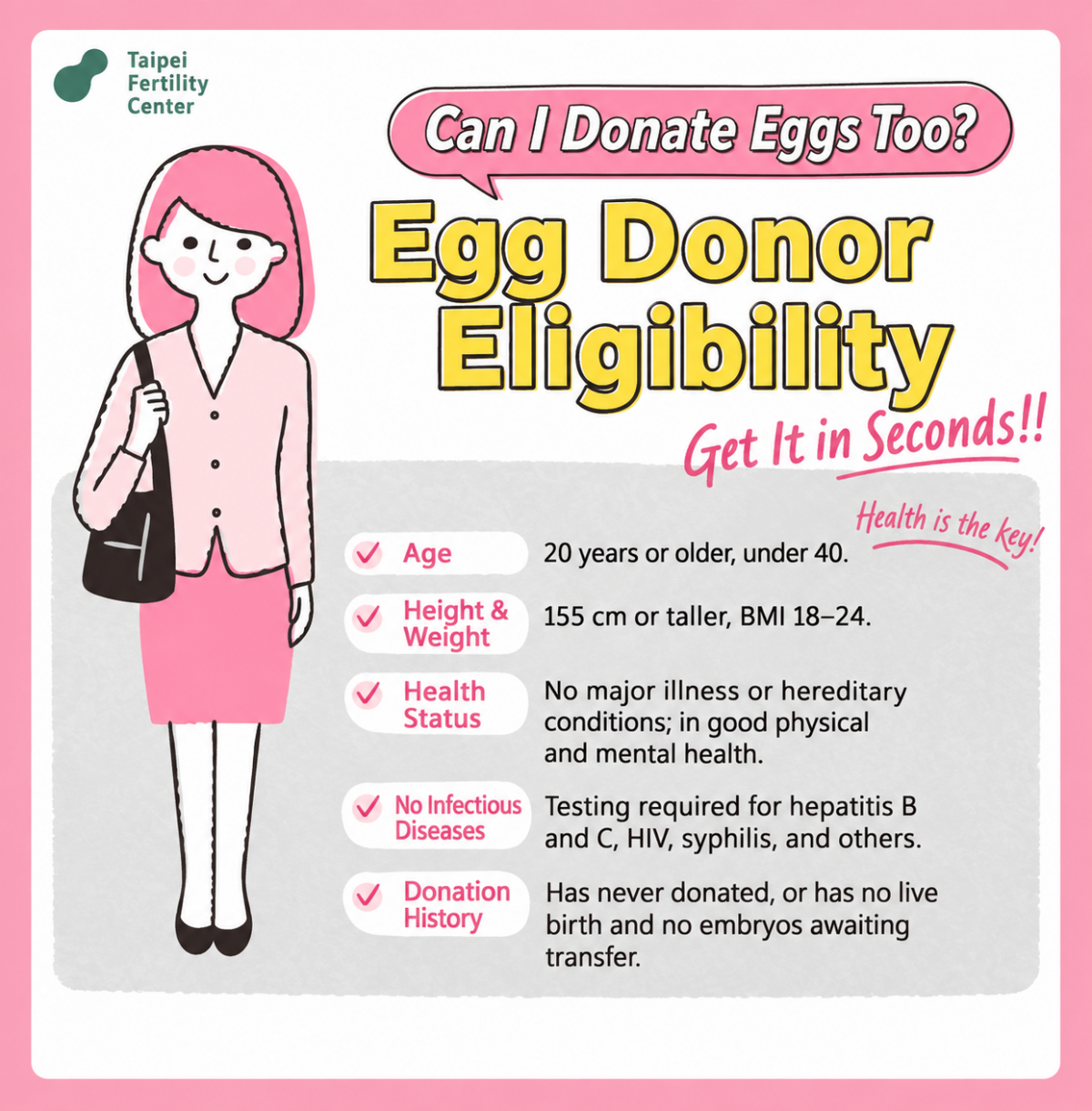
- Women aged 20 or older and under 40
- BMI between 18 and 24
- Has never donated before, or has donated before but the recipient couple did not achieve a live birth and has no stored embryos awaiting transfer
- Confirmed through screening to be in normal physical and mental health, with no hereditary or infectious diseases that could affect reproductive health
Who Cannot Donate Eggs?
Hereditary conditions or family medical history
If you or a family member has a hereditary condition such as a chromosomal abnormality, spinal muscular atrophy (SMA), Fragile X syndrome (FXS), epilepsy, hemophilia, thalassemia, diabetes, or color blindness, the health of future offspring may be affected.
Poor physical health
People who have a long-term chronic illness or have just completed major surgery are generally unable to withstand the medical process involved in egg donation, and their physical condition is not sufficient to support participation in a donation program.
Taking certain medications or having a history of mental illness
Women who need to take antidepressants, hormone therapy, weight-loss medication, or sleeping pills on a long-term basis may not be recommended for the donation program, because the stress of the process and interactions with these medications may interfere with each other.
Difficulty accepting the egg retrieval process
Egg donation involves a series of medical steps, including ovarian stimulation and an egg retrieval procedure. If you feel extreme discomfort with these procedures or cannot handle the psychological stress, you are not suited to be a donor.
IV. The Egg Donation Process: How to Donate Eggs
Step 1: Register Your Information
Register with a qualified medical institution that meets regulatory requirements, to help ensure the donation process is compliant and safe.
(Fill out the egg donation inquiry form here.)
Step 2: Personal Contact
After you pass the initial screening, a specialist from the institution will contact you by phone to confirm further details and answer any questions about the donation process.
Step 3: Pre-Treatment Health Screening
You will visit the clinic for a preliminary health screening, including blood tests, an ultrasound, infectious disease screening, and a psychological evaluation.
Step 4: Treatment and Egg Retrieval
Donors need to administer ovarian stimulation injections on schedule and attend regular follow-up visits, as directed by the doctor. You must fast for 8 hours before the egg retrieval procedure. The procedure takes about 10–20 minutes. After a 1–2 hour observation period to confirm there is no discomfort, you can prepare to leave the clinic and go home to rest.
(TFC provides a tasty, nourishing meal after the procedure!)
Step 5: Post-Procedure Follow-Up and Compensation Payment
At the follow-up visit, the doctor will use an ultrasound to check how your ovaries are recovering and ask about any signs of bloating, pain, or other discomfort. The compensation is transferred to you within approximately 14 business days.
(1) Pre-Donation Tests
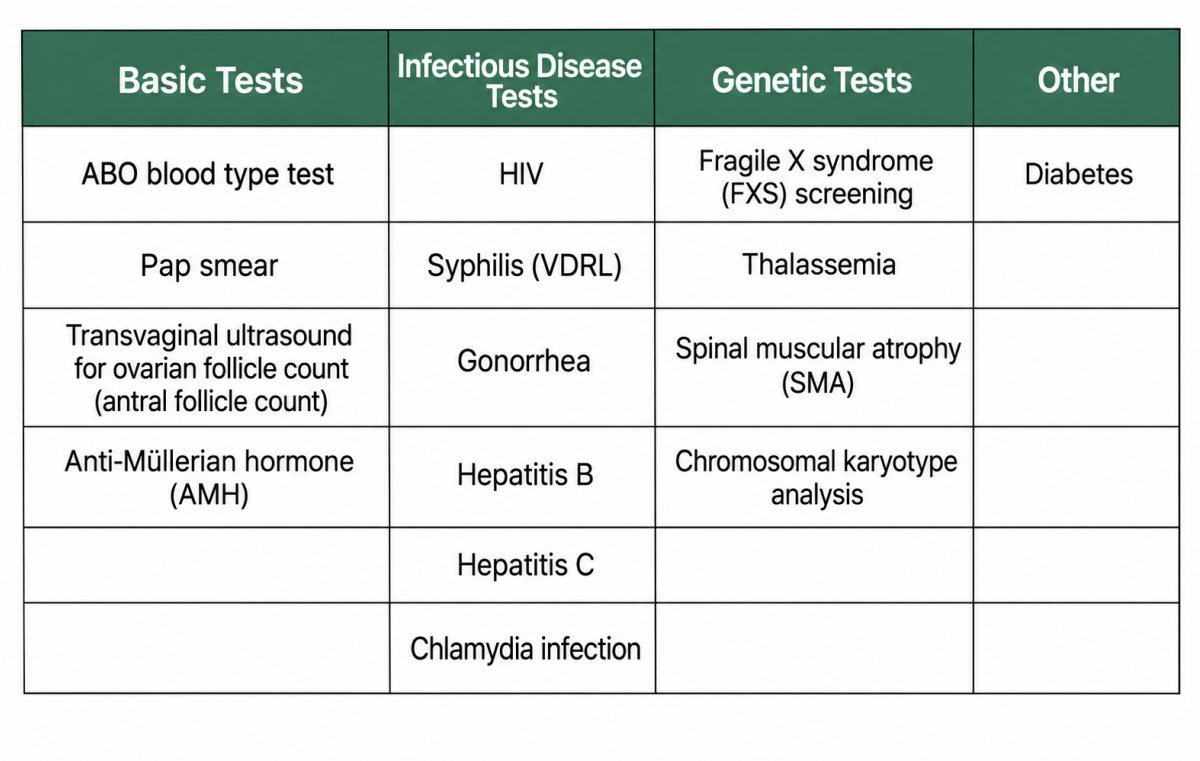
Pre-donation tests include blood tests, an ultrasound, infectious disease screening, and a psychological evaluation.
TFC’s tests include the following:
(2) How Many Days Does the Egg Donation Process Take?
From the start of the donation treatment to the end of the egg retrieval procedure, the process usually takes 10–14 days. However, the earlier stages, including the health screening, submitting your information to the Health Promotion Administration for review, and waiting to be matched, may take 2 to 6 months.
V. Egg Donation Side Effects and Risks
(1) What Are the Risks of the Egg Retrieval Procedure? Does It Hurt?
Although the risks of egg donation are relatively low, the process involves ovarian stimulation injections, so a very small number of donors may experience discomfort or related complications. The following are 6 possible situations:
Reactions to the ovarian stimulation injections
Everyone responds differently to ovarian stimulation injections. Some people may experience local discomfort or a mild allergic reaction, such as redness, swelling, or bruising.
Ovarian Hyperstimulation Syndrome (OHSS)
This occurs when ovarian stimulation injections cause many follicles to grow at the same time. In the vast majority of cases, the hyperstimulation is mild. A small number of people may experience symptoms such as bloating, nausea, vomiting, dizziness, heart palpitations, decreased urine output, or weight gain.
Ovarian torsion
This is very rare. It also results from ovarian enlargement after hyperstimulation. Strenuous exercise or impact may cause the ovary to twist, leading to sudden, severe abdominal pain that requires emergency surgery.
Risks of sedation anesthesia
Egg retrieval is usually performed under sedation (twilight anesthesia). Possible risks include low blood pressure, allergic reactions, arrhythmia, cardiac arrest, carbon dioxide embolism, pulmonary edema, metabolic acidosis, pneumonia, hypoventilation, and bronchospasm.
Procedure-related risks
Although the retrieval needle is very thin, the blood vessels of a hyperstimulated ovary are richer, so there may be a risk of bleeding, infection, or nerve injury. Most bleeding stops on its own, but in very rare cases, surgery may be needed to stop it.
Abdominal pain
Although egg retrieval is a simple and quick procedure, it is still an invasive one. Some people experience abdominal pain or bloating afterward, which can usually be relieved with pain medication or rest.
(2) Precautions for Egg Retrieval
- Avoid strenuous exercise such as running and weight training once treatment begins.
- After the procedure, you can return to a normal diet. We recommend eating more high-protein foods, such as eggs and fish, to support your body’s recovery.
- Attend your follow-up visit after the procedure as instructed by your doctor, so that your recovery can be checked.
- Avoid sexual intercourse during the donation treatment, and wait until your body has fully recovered.
VI. Where Can You Donate Eggs?
Under Taiwan’s laws, egg donation must be carried out at a government-approved medical institution, such as a fertility center or an obstetrics and gynecology clinic, to protect the rights of both donors and recipients and to help ensure the medical process is safe.
(List of assisted reproduction institutions approved by the Ministry of Health and Welfare)
(1) What Is the Difference Between Egg Donation in Taiwan and Abroad?
In terms of privacy protection, egg donation in Taiwan is fully anonymous, which safeguards the privacy rights of both donors and recipients, and no personal information is disclosed. In some other regions, recipients are allowed to learn the donor’s basic information, so privacy protection is relatively weak.
In terms of health and safety, egg donation in Taiwan is managed from start to finish by professional medical institutions, which provide detailed explanations of the risks and post-procedure care to protect the donor’s health. Abroad, donations are mostly recruited and arranged by agents, with little medical support, and the donor must bear the risks herself.
As for additional incentives, Taiwan’s laws limit the amount of compensation, so the decision to donate focuses more on health and the public good. Abroad, donation is often promoted with high compensation and free travel, which can hide health risks such as ovarian hyperstimulation.
VII. Recommended Egg Donation Clinic
Among the many egg donation institutions, TFC Taipei Obstetrics and Gynecology Clinic has become a reassuring choice for many donors, thanks to its rigorous donation process, professional medical expertise, and comprehensive privacy protection:
Experienced medical team
Our team of senior physicians, experienced nurses, and counselors designs each treatment plan around the donor’s health condition, with care taken at every step.
A convenient and comfortable clinic environment
The clinic is located in Nanshan Plaza in Taipei’s Xinyi District, in an elegant, comfortable setting with very convenient transportation.
Comprehensive and diverse services
We offer health screening, nutrition and psychological counseling, and welcome donors of all gender identities.
VIII. Egg Donation FAQs and Myths
Q: Will egg donation make me gain weight?
No. However, because hormone medications are used to stimulate ovulation during treatment, you may experience short-term swelling, changes in appetite, or weight fluctuations.
Q: Will egg donation affect my chances of getting pregnant?
No. A woman can release far more eggs over her lifetime than she actually needs, and the eggs retrieved during a donation cycle make up only a small portion of them.
Q: Can I still have children after donating eggs?
Yes. Egg donation retrieves only some of your eggs and does not affect the long-term function or reserve of your ovaries.
Q: Will egg donation bring on menopause earlier?
No. The eggs retrieved in a donation cycle are those that would have naturally been lost that month. Your ovaries will continue to produce eggs and maintain a normal menstrual cycle until you reach the age of natural menopause.
Q: How long after giving birth can I donate eggs?
We recommend waiting at least 6 months after giving birth before considering egg donation, to make sure your body has fully recovered and your hormone levels are stable.
Q: Will there be a record of my egg donation?
Yes, but the record is confidential and can only be accessed by the donation institution.
Q: Will the recipient couple know my information?
No. The donor’s information is kept completely confidential and is not made public or disclosed to recipients.
Q: Can I choose who receives my eggs?
No. Matching is arranged by the medical institution.
Q: Can I change my mind and ask for my eggs back after donating?
No. Donors have no right to request their eggs back. However, if a donor is diagnosed by a doctor with a fertility problem after donating, she may still apply for the return of any eggs that have not been used or destroyed.
Q: Could I accidentally donate to a relative?
No. The medical institution will avoid this situation, and the donor and the recipient couple cannot be related within the fourth degree of kinship.
Egg donation is a caring choice that can help infertile families realize their dream of having a child. At the same time, donors should look after their own health, fully understand the entire process and its related risks, and make a well-considered decision.