












In Taiwan, the current Assisted Reproduction Act does not yet extend coverage to single women or same-sex couples. But this doesn't mean the door to parenthood is closed. An increasing number of prospective parents with fertility plans are choosing to first complete egg retrieval, egg freezing, or sperm freezing at TFC Taipei Fertility Center—known for its advanced technology and patient-friendly treatment—before safely transporting their reproductive cells abroad (such as to the United States) for subsequent IVF or surrogacy procedures.
Is this cross-border path to parenthood feasible? What conditions need to be met? How should costs and timelines be estimated? This article provides a comprehensive breakdown covering regulatory restrictions, the complete process, and frequently asked questions.
Who Should Consider International Transport of Reproductive Cells?
The international export of reproductive cells (sperm, eggs) or embryos currently applies mainly to the following groups with cross-border fertility needs:
- Single women or lesbian couples: After completing egg freezing in Taiwan, eggs are exported overseas, where donor sperm is obtained from an overseas sperm bank to undergo IVF treatment locally (carrying the pregnancy themselves).
- Lesbian couples pursuing reciprocal IVF (one partner's eggs, the other carrying): One partner completes egg freezing in Taiwan and applies for export, then seeks a legally licensed medical institution abroad to complete fertilization and embryo transfer.
- Single men or gay male couples: After completing sperm freezing in Taiwan and applying for export, they plan to use legally obtained donor eggs abroad along with surrogacy resources to complete their family-building plan.
- Those seeking overseas surrogacy: Individual cases requiring legal surrogacy abroad due to medical or personal reasons.
The Complete Process for International Egg/Sperm Export: Plan for 6 Months from First Visit to Arrival Overseas
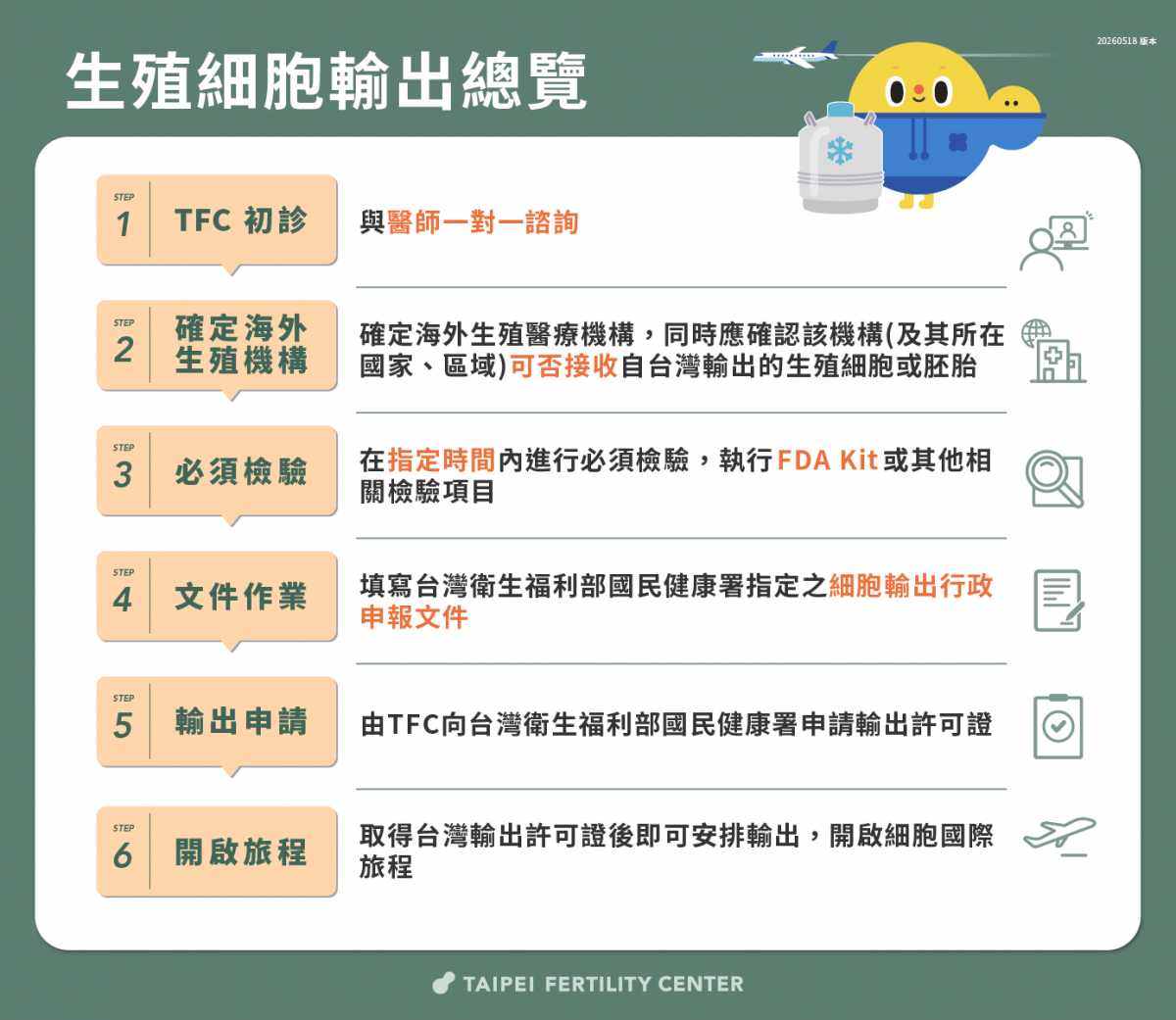
The overall process for the international export of reproductive cells is quite rigorous. From the initial medical evaluation to the completion of international cold-chain transport, you should generally allow approximately 6 months of preparation time. Below is TFC Taipei Fertility Center's standard operating procedure:
① Initial Consultation and Evaluation at TFC
One-on-one expert consultation: A TFC reproductive medicine specialist will arrange testing for you, learn about your health status, medical history, and fertility plans, and discuss the cross-border treatment path best suited to you.
Freezing procedure: Following your doctor's guidance, complete high-quality egg freezing, sperm freezing, or embryo culture at TFC—taking the first step toward welcoming your baby.
② Confirm a Legally Licensed Reproductive Institution Abroad
Based on your fertility goals, identify and confirm a legally licensed reproductive center abroad. Besides the popular choice of the United States, other countries are also available (please consult TFC's International Medical Advisory Team for details).
Note: Be sure to confirm that the institution and its country's regulations permit receiving reproductive cells or embryos exported from Taiwan. Receiving requirements, required documents, and associated fees vary by institution, so careful coordination with the overseas party is essential.
③ Complete Required Medical Testing (Including the FDA Kit)
Different overseas reproductive institutions have their own strict time windows for infectious disease testing and physical examinations. Take the most common case of pursuing treatment in the U.S. as an example:
What is FDA Kit testing? This is a specialized testing panel required under U.S. FDA regulations, used to confirm that the cell donor is free of specific infectious diseases, ensuring compliance with U.S. import safety standards.
Tests included: FDA Kit, HIV, syphilis, hepatitis B, hepatitis C, rubella, and a physical examination, among others.
Time restrictions: Requirements vary by state, but some mandate that testing be completed within 30 days before and 7 days after egg or sperm retrieval. Be sure to coordinate closely with TFC's International Medical Advisory Team on timing.
④ Prepare Administrative Documents and TECO Certification
Complete the required documentation for the Taiwan-side export application at TFC.
The overseas reproductive institution must provide a "Letter of Acceptance," which must be certified by the local Taipei Economic and Cultural Office (TECO) before the original document is submitted to TFC. This certification process typically requires assistance from the overseas institution or a professional transport company.
⑤ Apply for an Export Permit from the Health Promotion Administration
Once all documents are ready, TFC's professional team will assist in formally submitting a "Reproductive Cell Export Application" to Taiwan's Ministry of Health and Welfare, Health Promotion Administration.
Review time depends on the authority's processing schedule, generally taking about 1–2 months. Once approved, you'll receive a legal cell export permit.
⑥ Engage a Professional Medical Cold-Chain Company for International Transport
After obtaining the permit, the overseas institution or TFC will help connect you with a professional international cell transport company to confirm the shipping date.
You pay the shipping fee directly to the transport company, while the rigorous temperature-control and customs clearance procedures are fully handled by the professional team, ensuring your eggs or sperm arrive safely at their destination.
Reference Costs for International Egg/Sperm Export
International fertility procedures involve medical, administrative, and logistics costs. Below is a general cost range for reference:
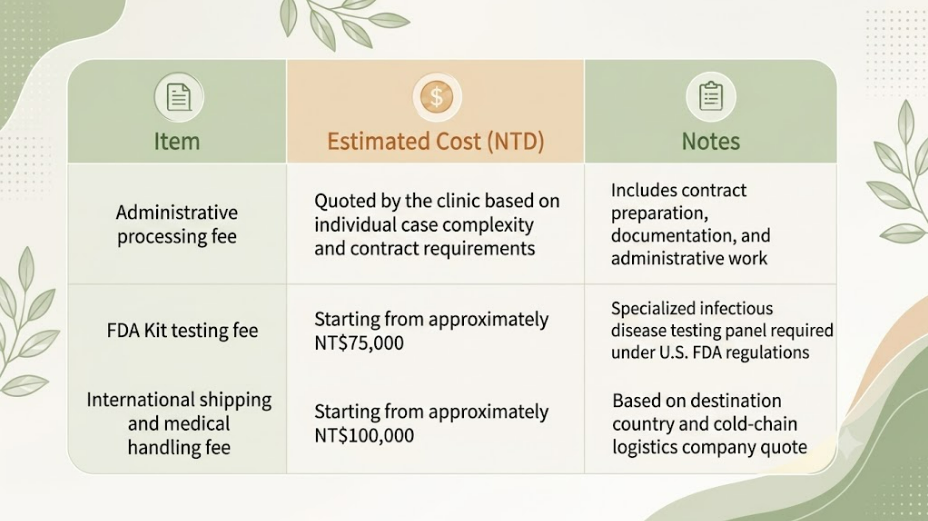
The above costs are general market reference ranges; actual medical procedures and quotes will vary based on individual treatment plans.
Important Regulatory Notice: Which Cells Cannot Be Exported from Taiwan?
Under the Health Promotion Administration's "Regulations Governing Applications for the Import and Export of Reproductive Cells and Embryos," the following are legally prohibited from export or import, in order to safeguard ethical standards and the integrity of genetic lineage:
-
Reproductive cells obtained through "donation" (for example, cells obtained from donated eggs or sperm received in Taiwan).
-
Embryos already formed using donated material.
Core principle: Only sperm or eggs provided by the individual themselves, and embryos formed from that individual's own sperm and eggs, are eligible for legal international export.
Frequently Asked Questions About International Egg/Sperm Export
Q1: Can eggs or sperm only be exported to the United States?
No. While going to the U.S. for subsequent treatment (such as overseas surrogacy) is currently the most common path due to well-established regulations there, as long as the destination country's reproductive center complies with that country's laws and is willing to receive cells from Taiwan, the same export application process can be carried out through the Health Promotion Administration.
Q2: I've already frozen my eggs at another hospital—can TFC still help me with the export process?
Yes. After first contacting your intended overseas institution to confirm their willingness to accept the cells, you can transfer the cells to TFC, or have TFC help you complete the necessary FDA testing and administrative documents to begin the export application. We recommend scheduling a consultation at TFC's International Medical clinic, where our team can help assess whether your existing test results meet the requirements.
Q3: If I didn't complete FDA testing before egg retrieval, can I do it afterward?
Regulations vary by country and state, and some overseas clinics do accept testing completed afterward. However, it's important to note: if FDA Kit testing isn't completed before egg or sperm retrieval, your options when seeking a surrogate later on may be significantly limited—because surrogates are legally entitled to decline the use of reproductive cells that haven't been pre-tested. For this reason, arranging FDA testing at TFC in advance is the best way to protect your future options.
Choose TFC for Proven International Medical Coordination Experience, and Let Your Journey to Parenthood Begin Smoothly
The international export of reproductive cells spans the legal systems and medical regulations of two countries, and the complexity of document preparation and communication often exceeds expectations. Choosing TFC Taipei Fertility Center—with its leading reproductive technology, extensive international coordination experience, and dedicated international medical advisors—not only saves you from navigating this process alone, but is also key to ensuring your precious cells arrive safely and in optimal condition, ready for the next stage of your journey to parenthood.
Let TFC walk you through every step of your cross-border journey to parenthood. We welcome you to [schedule a consultation at TFC Taipei Fertility Center], where our international medical team will design a personalized export plan tailored just for you.
This article references information from Taiwan's Ministry of Health and Welfare Health Promotion Administration and TFC Taipei Fertility Center's clinical practice. Please refer to the latest official announcements from the relevant authorities for any regulatory updates.
