












With more women pursuing diverse career paths and lifestyle choices, family planning timelines have also become more varied. However, unlike outward appearance, women's fertility declines steadily with age, which is a biological reality that cannot be overlooked. Egg freezing, often regarded as a gift of modern science, walks you through the egg-freezing process and procedure in this article, offering women the option to preserve their reproductive rights, allowing them to take greater control of their lifestyle and future.
Egg Freezing Insight #1: Is There an Age Limit for Egg Freezing?
Despite there being no absolute age limit for egg freezing, both the quantity and quality of retrievable eggs decline with age. The optimal age range for egg freezing is typically between 30 and 35, as this is when the number and quality of retrievable eggs are at their highest, making it the most cost-effective period. That said, under normal healthy conditions, there is no need to freeze eggs prematurely, as the procedure carries surgical risks and requires ongoing storage fees. However, after the age of 39 to 40, the benefits of egg freezing decline sharply. Therefore, the earlier the eggs are frozen, the better their quality, and the higher the future success rate of IVF.
Egg Freezing Insight #2: How Much Does Egg Freezing Cost?
The total cost for egg freezing typically ranges from NT$120,000 to NT$150,000, depending on factors such as the medications used, the number of eggs retrieved, and required medical supplies. In addition, an annual storage fee for the frozen eggs applies, usually around NT$10,000 per year.
Egg Freezing Insight #3: How Long Does the Egg Freezing Process Take?
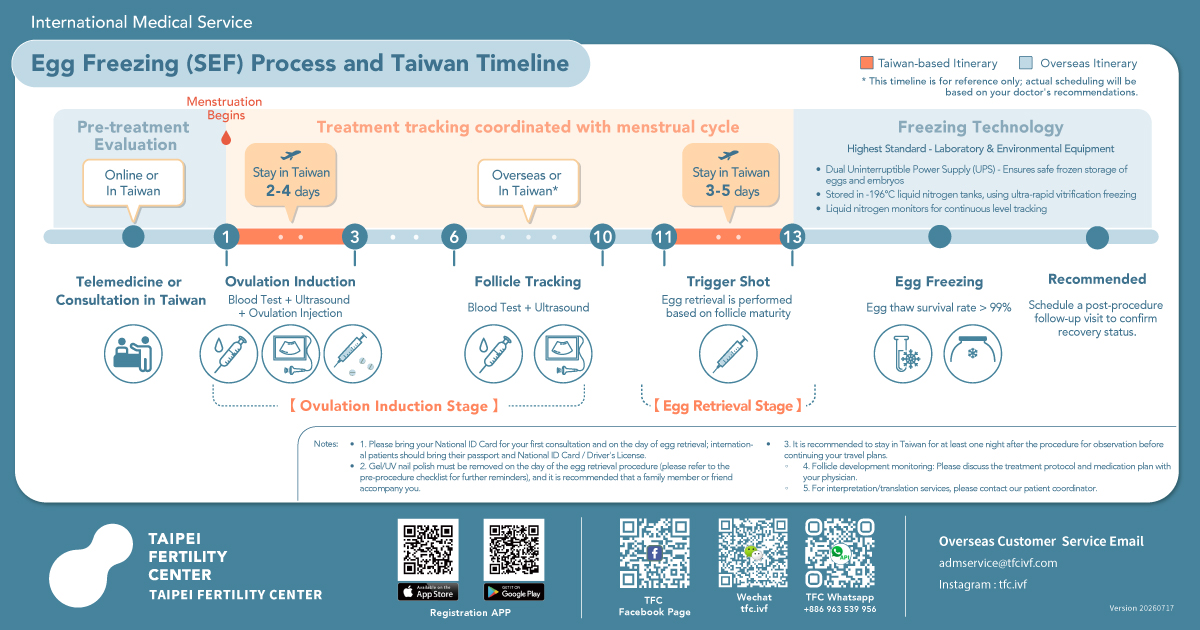
From the start of the process to egg retrieval, the process usually takes about 14 days. This relatively simple procedure generally does not cause significant disruption to your daily life or work schedule.
Egg Freezing Insight #4: How Many Eggs Should Be Retrieved in One Treatment Cycle?
The number of eggs needed for a reasonable chance of future pregnancy largely depends on age, since egg quality drops naturally over time.
-
For women under 35, each thawed mature egg has an estimated live birth rate of 4 to 5%. Therefore, freezing 20 to 25 mature eggs on average offers an 80 to 90% chance of a successful pregnancy.
-
At ages 36 to 37, freezing 20 mature eggs offers about a 70% chance of success.
-
By ages 40 to 41, freezing 20 mature eggs offers only about a 40% chance of success.
-
At age 44, even with 20 successfully frozen mature eggs, the chance of a single successful pregnancy is only about 10%.
Egg Freezing Insight #5: How Is the Egg-Freezing Procedure Performed?
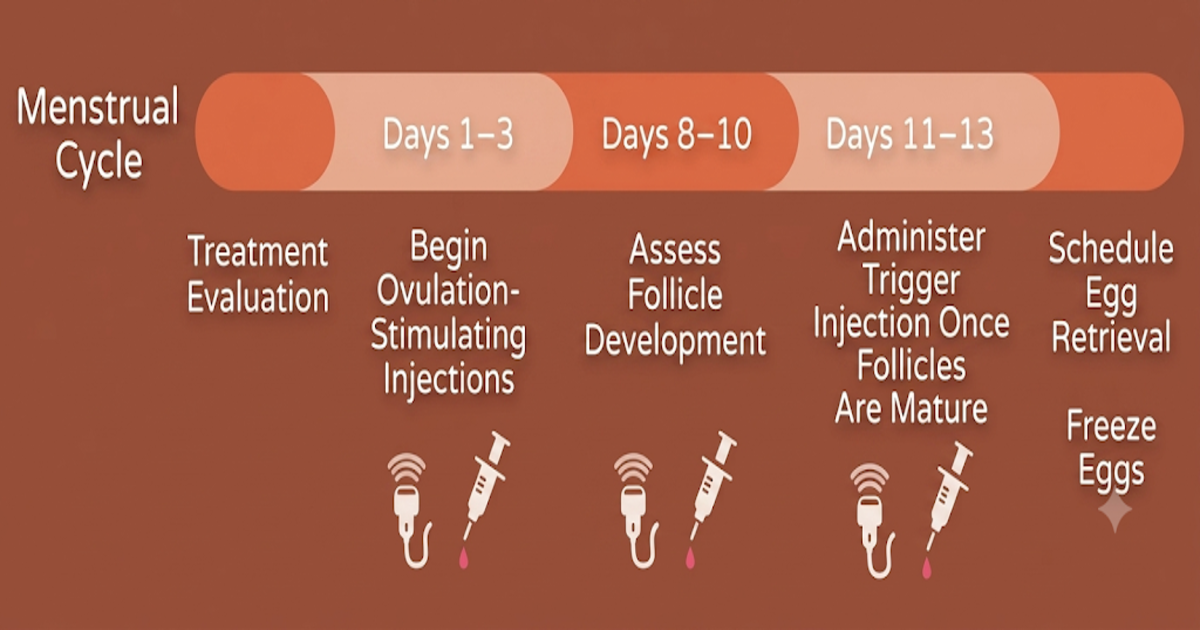
On days 1 to 3 of the menstrual cycle, the process begins with blood tests and ultrasound scans to assess ovarian status. The doctor will then assess egg status and adjust hormone medications, using ovulation-stimulation injections to increase the number of eggs retrieved. Around days 6 to 10, 2 to 3 follow-up visits are required for ultrasound monitoring of egg maturity and size. Lastly, a trigger injection is given to help mature follicles rupture and release the eggs, followed by the egg retrieval procedure to collect and freeze the mature eggs.
Egg Freezing Insight #6: Is There a Storage Time Limit for Frozen Eggs?
According to Taiwan's Assisted Reproductive Technology regulations, embryos can be frozen for up to 10 years, but eggs and sperm may be stored for longer periods, provided that the provider's written consent is obtained.
Egg Freezing Insight #7: Are There Any Side Effects of Egg Freezing?
A common misconception is that egg retrieval hastens the onset of menopause, but this is incorrect. Each menstrual cycle, the ovaries recruit a group of follicles, but typically only one becomes the dominant follicle and releases a mature egg. The remaining follicles undergo atresia (natural degeneration). During an egg-freezing cycle, ovarian stimulation medications are used to help mature multiple follicles that would otherwise undergo natural degeneration, rather than depleting the future ovarian reserve. Importantly, research to date shows no evidence that oocyte cryopreservation leads to earlier menopause or long-term depletion of ovarian reserve.
Egg freezing is an important choice enabled by modern technology, offering women greater autonomy and the flexibility to manage their fertility plans more freely. However, each woman's situation is unique, so it is recommended to consult with a fertility specialist to better understand your body and individual needs before making an informed decision. Regardless of the path chosen, maintaining a healthy lifestyle and diet habits remains key to preserving egg quality and reproductive health. This modern technology allows women to better balance career and family, achieving their personal life goals.
Why Choose TFC Taipei Fertility Center for Egg Freezing?
Founded and led by reproductive medicine authority Dr. Tseng Chi-Jui, TFC Taipei Fertility Center offers comprehensive fertility planning, including AMH testing and egg-freezing assessments, empowering women to pursue their goals freely, unconstrained by age, career stage, or marital status.