













Table of Contents
-
1. AMH Testing Overview: How Is Ovarian Function Assessed? Who Should Be Tested?
-
3. AMH Levels by Age: Reference Values for Ovarian Reserve Across Age Groups
-
4. What to Do About Abnormal AMH Levels? Causes of Low AMH and Next Steps
1. AMH Testing Overview: How Is Ovarian Function Assessed? Who Should Be Tested?
An AMH test is a blood test that helps assess ovarian reserve (egg quantity). However, ovarian fertility function does not depend on quantity alone. Egg quality (the rate of chromosomally normal embryos) is equally important, and the two together influence the chances of conception. Below, we explain how AMH testing is done, what the results mean, and who may benefit from testing.
(1) What Is AMH? Understanding How Ovarian Reserve Is Assessed
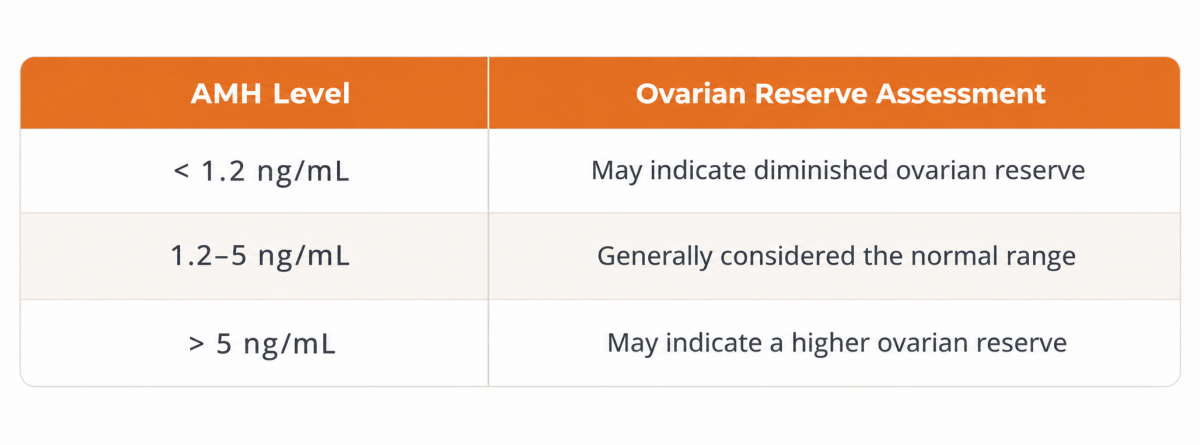
AMH (Anti-Müllerian Hormone) is a hormone secreted by the small follicles in the ovaries, and it serves as an important reference indicator of a woman’s ovarian reserve (egg quantity). A woman’s egg supply is determined at birth and gradually declines with age. This differs from men, who continue to produce sperm, so ovarian reserve changes over time. However, AMH mainly reflects egg quantity. It cannot determine egg quality or represent overall fertility, so results should be evaluated together with age and other test results.
The table below summarizes what common AMH ranges generally indicate:
(2) Who Should Get an AMH Test, and Why?
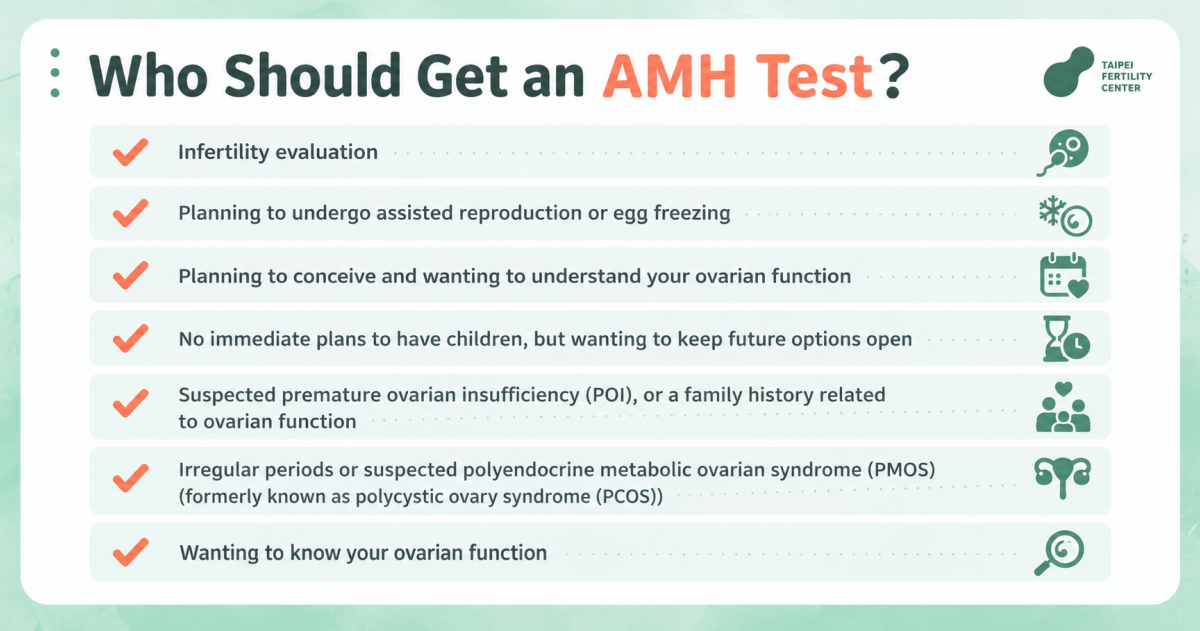
AMH is an important test before infertility evaluation, assisted reproduction, or egg freezing, and it can also serve as a decision-making reference for people who are planning to conceive. The groups below are commonly suited to AMH testing:
-
Infertility evaluation: AMH testing helps identify the cause of infertility and is an essential part of fertility workups.
-
Planning to undergo assisted reproduction or egg freezing: AMH can give a rough estimate of how the ovaries may respond to ovulation medications, how many eggs may be retrieved, and the risk of ovarian hyperstimulation syndrome (OHSS). The American Society for Reproductive Medicine (ASRM) also recommends testing before treatment.
-
Planning to conceive and wanting to understand your ovarian function: AMH cannot predict the chance of natural conception, and a low AMH does not mean you cannot conceive naturally. However, understanding your ovarian function before trying to conceive can sometimes be helpful. For example, if your AMH is low, you may consider shortening the time you spend trying naturally and consult a fertility specialist for evaluation earlier, if needed.
-
No immediate plans to have children, but wanting to keep future options open: International society guidelines do not recommend using AMH to determine the need for egg freezing, as age is considered the more important factor. In clinical practice, however, women with clearly low AMH tend to retrieve fewer eggs per cycle, so undergoing treatment while younger and when egg quality is better may be easier. AMH is only a reference. Age and your own family-planning wishes matter most.
-
Suspected premature ovarian insufficiency (POI), or a family history related to ovarian function: If your menstrual cycles have been gradually getting shorter, your periods have changed noticeably, or female relatives such as your mother or aunts went through menopause before age 45, AMH testing combined with other tests can help you understand the condition of your ovaries.
-
Irregular periods or suspected polyendocrine metabolic ovarian syndrome (PMOS), formerly known as polycystic ovary syndrome (PCOS): AMH levels are now part of the PMOS diagnostic process. A high AMH level or an excessive number of small follicles on ultrasound, together with irregular periods or elevated androgen levels, can lead to a PMOS diagnosis, and AMH can also help doctors plan treatment.
-
Simply wanting to know your ovarian function: Apart from specific conditions such as POI and PMOS mentioned above, AMH has not been proven to directly affect overall health, and it cannot predict the age of menopause. If you do not plan to have children, major medical societies do not recommend routine AMH testing. However, people who have had ovarian surgery, radiation, or chemotherapy, or who simply want to know their current ovarian function, may still choose to be tested according to their own needs, once they fully understand what AMH can and cannot tell them.
2. How Is AMH Tested? Cost and Retesting Timing at a Glance
AMH testing is done mainly through a blood draw. You do not need to fast, and the result is not affected by your menstrual cycle, so scheduling is relatively convenient. Beyond the testing process and cost, the right time to recheck your AMH also varies depending on your family-planning goals, age, and ovarian condition. Below, we explain how AMH is tested, what it costs, and how often to retest.
(1) How Is AMH Tested? A Complete Guide from Testing Methods to Costs
The biggest advantage of AMH testing is that it is simple and not time-restricted. It requires only a blood draw, with no need to match a specific point in your menstrual cycle or to fast, so you can schedule the test whenever suits you. Results are usually available about 1–2 hours after the blood draw. However, AMH testing generally has to be paid for out of pocket, and the cost is roughly NT$800–1,500, though the actual price varies by medical facility.
(2) How Often Should You Test AMH?
AMH levels change with age and ovarian function. If you would like to keep track of your ovarian reserve, it is generally suggested to retest about every 1–2 years after age 30, depending on your age, family-planning goals, and physical condition. Women aged 30–35 who are considering having children or freezing eggs in the future can also use AMH testing to understand their ovarian reserve earlier.
However, people who have had ovarian surgery or cancer treatment, have a family history of premature ovarian insufficiency (POI), or have noticeable changes in their menstrual cycle are advised to discuss the testing frequency and timing with a doctor first.
3. AMH Levels by Age: Reference Values for Ovarian Reserve Across Age Groups
If you would like to know whether your AMH level falls within the typical range for women your age, you can refer to the median AMH distribution across age groups. However, a lower-than-average AMH for your age does not mean you will be infertile, nor does it mean your AMH will decline faster than others’. The data below is for reference only when assessing ovarian reserve and should always be interpreted together with a doctor’s evaluation.
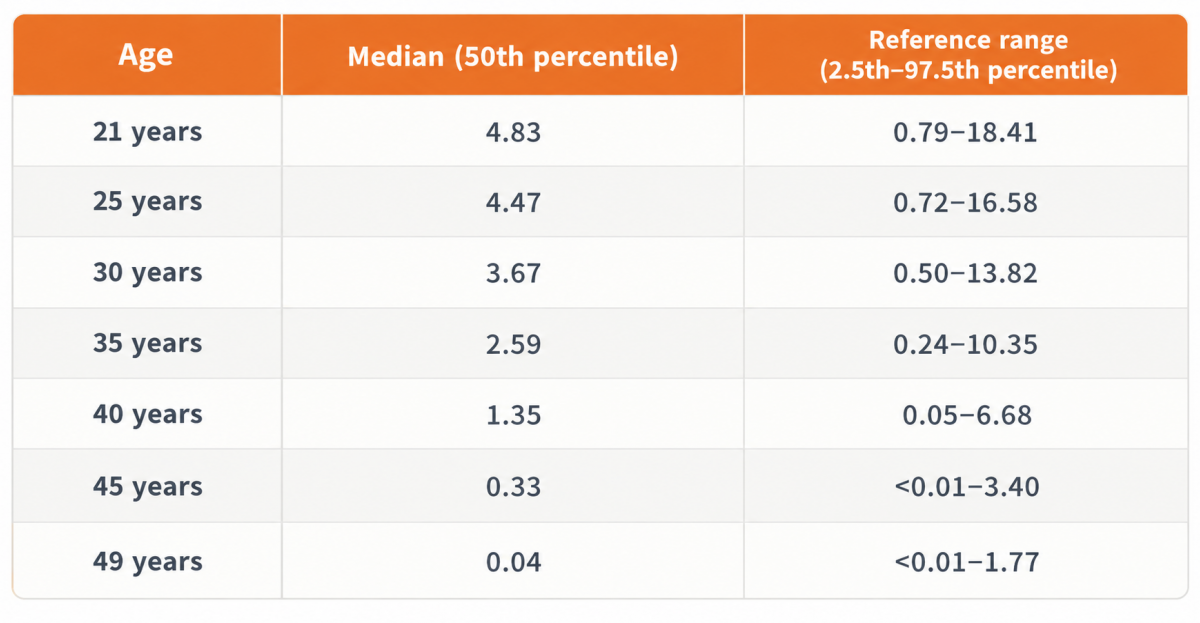
The data above shows that median AMH levels tend to decline with age. However, AMH levels are still affected by individual constitution and health status, so test results can differ even among women of the same age group.
4. What to Do About Abnormal AMH Levels? Causes of Low AMH and Next Steps
When AMH is lower than the typical range for your age, it may be related to factors such as age, medical conditions, surgery, or changes in ovarian function. If AMH is high, other tests are also needed to find out why. Below, we explain the common causes of abnormal AMH levels and how each situation is evaluated and managed.
(1) Why Is My AMH Low? Possible Causes of Low AMH Levels
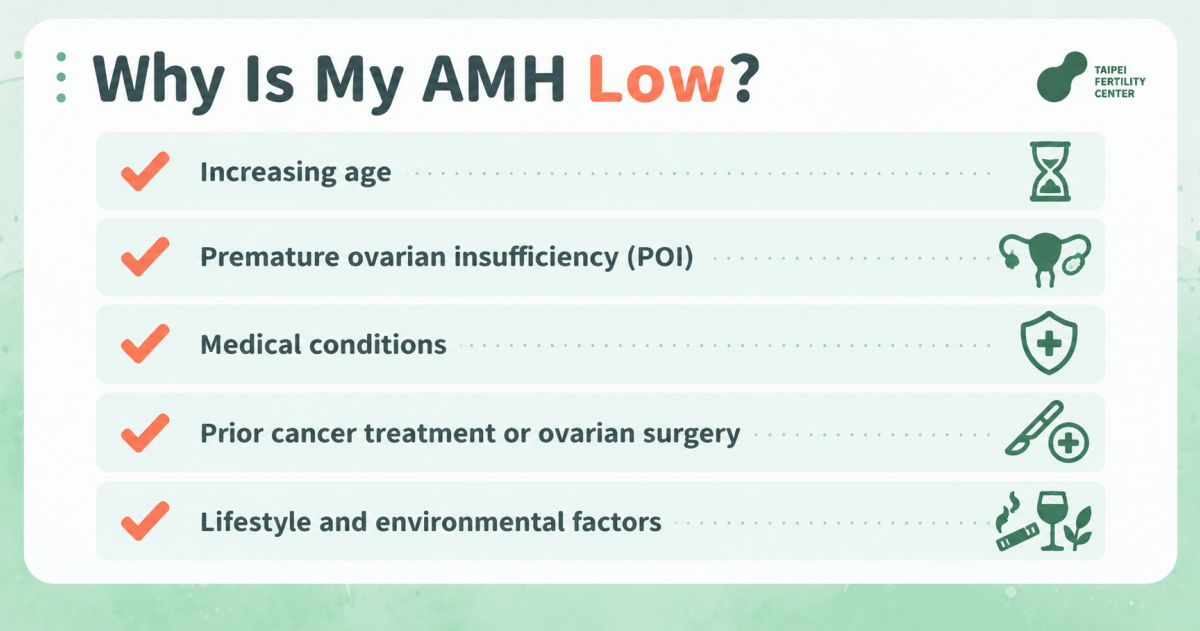
A low AMH level usually indicates a smaller ovarian reserve, but age is not the only possible cause of a decline in AMH. It may also be related to medical conditions, surgery, genetic factors, and living environment. Common causes include:
-
Increasing age: A woman’s egg supply is largely fixed at birth. As she gets older, eggs are gradually used up and ovarian reserve declines, so AMH levels typically trend downward.
-
Premature ovarian insufficiency (POI): Some women may experience an early decline in ovarian function at a younger age, which reduces ovarian reserve and results in an AMH level below the average for their age. If there is a family history of early menopause or early decline in ovarian function, the risk of a lower AMH may also be higher.
-
Medical conditions: Certain gynecological conditions (such as endometriosis) or autoimmune diseases may reduce ovarian reserve and affect AMH levels.
-
Prior cancer treatment or ovarian surgery: Chemotherapy, radiation therapy, or ovarian surgery may affect ovarian tissue and ovarian reserve, lowering AMH levels.
-
Lifestyle and environmental factors: Long-term smoking, excessive drinking, poor nutrition, or exposure to environmental pollutants may all affect overall reproductive health and indirectly affect ovarian function.
(2) What to Do If AMH Is Too Low or Too High? An Overview of Each Approach
A high or low AMH level does not mean you will definitely be able to conceive or definitely be unable to. It is an important reference for ovarian reserve. Doctors usually evaluate it together with your age, ultrasound follicle count, and other hormone tests, and then plan your next steps for family planning based on your individual situation.
- AMH is too low: A low AMH indicates a smaller ovarian reserve, but it does not mean egg quality is poor, and AMH alone cannot determine the chance of natural conception. If you are planning to have a child now, it is advisable to see a fertility specialist early to find the right timing for trying to conceive. If you plan to have children in the future, you can also discuss with your doctor whether egg freezing may be worth considering. At the same time, maintaining a balanced diet, getting enough sleep, not smoking, and keeping a regular routine can help lay a foundation for reproductive and overall health.
- AMH is too high: A high AMH usually indicates a larger number of small follicles in the ovaries, but a higher number is not necessarily better. Some women with polyendocrine metabolic ovarian syndrome (PMOS, formerly known as PCOS) may also have a high AMH. If you also have irregular periods or ovulation problems, further ultrasound and hormone testing is advised so a doctor can identify the cause. If you are preparing for IVF treatment, your doctor will also use AMH to assess how your ovaries may respond to ovulation medications and adjust the medication approach accordingly.
5. AMH Testing FAQ: What Else You Should Know
Q1: Why Does AMH Drop Quickly?
AMH levels usually decline gradually with age. If a noticeable drop appears over a short period, it may be related to external effects on the ovaries in addition to natural physiological changes. Common causes include previous ovarian surgery (such as surgery for endometriomas, also known as “chocolate cysts,” or other ovarian cysts) and cancer treatment (such as chemotherapy or radiation therapy).
However, AMH levels can also be affected by measurement variation, testing methods, and individual health conditions, so a single lower reading does not necessarily mean ovarian function has suddenly declined sharply. For example, long-term use of oral contraceptives may temporarily lower AMH, but this does not mean ovarian function has truly worsened. If your AMH changes noticeably over a short period, it is advisable to have a doctor evaluate your ovarian status together with your age, menstrual pattern, ultrasound findings, and other hormone levels.
Q2: How Can I Maintain My AMH Level?
Currently, there is no known way to increase an ovarian reserve that has already declined. However, maintaining healthy lifestyle habits may help support overall reproductive health. In daily life, you can start with the following:
- Maintain a balanced diet and regular routine: Get enough protein, vegetables, fruits, and a variety of nutrients, and get adequate sleep to keep your body in a stable condition.
- Avoid habits that may affect ovarian health: Avoid smoking and excessive drinking, as well as long-term exposure to environmental factors that may disrupt the endocrine system.
- Assess overall uterine, ovarian, and hormonal status: If you are planning to conceive or freeze your eggs, AMH testing combined with other tests can help you understand your fertility status.
Q3: Can AMH Predict When Menopause Will Occur?
AMH cannot precisely predict an individual’s age at menopause, because the actual timing is influenced by many factors, including genetics, physical condition, and lifestyle. Menopause that occurs too early may require additional hormone supplementation to maintain bone and cardiovascular health. If you have a family history of premature ovarian insufficiency (POI), noticeable changes in your menstrual cycle, or concerns about an early decline in ovarian function, other tests are needed in addition to AMH to determine whether menopause is approaching and whether genetic testing is needed to investigate the cause of POI.
Q4: Does a High AMH Mean It’s Easier to Get Pregnant?
A higher AMH level only indicates a larger ovarian reserve. It does not mean egg quality is better, nor does it mean the chance of natural conception is higher. A woman’s fertility depends not only on egg quantity but also on many other factors, including age, egg quality (the rate of chromosomally normal embryos), ovulation, the uterine environment, and sperm quality.
In addition, some women may have a high AMH because of polyendocrine metabolic ovarian syndrome (PMOS, formerly known as PCOS). Although their ovarian reserve is large, they may also have problems such as irregular ovulation. Therefore, AMH should be interpreted together with other test results, and a doctor should evaluate overall fertility.
6. Where to Get an AMH Test? TFC Taipei Fertility Center Offers Professional Evaluation and Consultation
AMH testing is an important reference for assessing ovarian reserve and can help you understand your ovarian function and plan for your future family. However, AMH results still need to be interpreted by a medical professional together with your age, ultrasound findings, and other hormone levels in order to gain a fuller picture of your fertility.
TFC Taipei Fertility Center was founded by Dr. Chii-Ruey Tzeng, known as the “Father of IVF in Taiwan.” It brings together experienced fertility specialists, embryologists, and nursing staff to provide comprehensive reproductive medicine evaluations and personalized fertility planning. Combining AMH testing with related tests, the team helps women understand their ovarian reserve and, whether you are planning to conceive, considering egg freezing, or preparing for IVF treatment, develops a direction suited to your individual situation.
TFC has long been committed to reproductive medicine research and clinical care, building extensive experience in diagnosing and treating infertility. From the first consultation and testing to the planning of later treatment, we offer thorough and reassuring support. Through professional evaluation and the support of our medical team, we hope to help women understand their fertility earlier and be better prepared for their future family-building choices.
Want to know your AMH status? TFC Taipei Fertility Center is here to support you in planning your fertility with confidence.
