












What is PGS testing? This article explains how PGS works, who may benefit, what the process involves, and its limitations. It also covers typical PGS costs, pros and cons, and common questions. At the end, you’ll find information on clinics that offer PGS, so you can better understand embryo screening and plan your fertility choices with confidence.
Table of Contents
I. What Is PGS (PGT-A)? Who Should Consider Screening?
(1) What Is PGS? How Does It Relate to PGT-A and PGT?
II. PGS Testing Explained: What Can It Detect? How Does the Process Work?
(1) What Can PGS Detect? Understanding What It Tests and Its Limitations
(2) How Does PGS Testing Work? A Step-by-Step Guide to Embryo Screening
III. How Much Does PGS Cost? Per-Embryo Fees and Total Treatment Costs
IV. Is PGS Worth It? Understand the Pros and Cons Before You Decide
(1) What Are the Benefits of PGS?
(2) What Are the Drawbacks of PGS?
V. PGS FAQs: What to Know Before You Decide
Q2: How long does it take to get PGS results?
Q3: How many embryos should be tested?
Q4: Are pregnancy success rates higher with PGS?
Q5: Do I still need prenatal testing after PGS?
VI. Where Can You Get PGS? TFC Taipei Fertility Center Supports Your Fertility Journey
I. What Is PGS (PGT-A)? Who Should Consider Screening?
PGS is a chromosome test performed on embryos before transfer. It is mainly used to check whether an embryo has an abnormal number of chromosomes. In general, PGS may be worth considering for people who are planning a pregnancy at an older age, have had recurrent miscarriages, or have had several unsuccessful IVF cycles. Below, we explain how PGS works and when it may be appropriate.
(1)What is PGS? How Does It Relate to PGT-A and PGT?
PGS stands for Preimplantation Genetic Screening. It is a chromosome test done during IVF, before an embryo is transferred to the uterus. By analyzing the number of chromosomes in a few cells from the embryo, it helps doctors choose embryos with a healthier chromosome status for transfer.
In the field of reproductive medicine, PGS is now officially called PGT-A (Preimplantation Genetic Testing for Aneuploidy). The two names refer to the same test, which mainly checks embryos for an abnormal number of chromosomes.
PGS is one type of PGT (Preimplantation Genetic Testing). Depending on the purpose of testing, the most common types of PGT in clinical practice are:
-
PGT-A (formerly PGS): Checks whether an embryo has an abnormal number of chromosomes, which helps doctors select embryos that are more suitable for transfer.
-
PGT-M (formerly PGD): Tests for a specific single-gene (monogenic) disorder that runs in the family, such as thalassemia or hemophilia. It checks whether an embryo carries the genetic variant linked to that condition, which lowers the risk of passing it on to your child.
-
PGT-SR: Tests for structural chromosome abnormalities, such as rearrangements or translocations, where a piece of one chromosome breaks off and attaches to another chromosome. It is suitable when one partner carries a structural chromosome abnormality.
PGS can help identify euploid embryos (embryos with the normal number of chromosomes), which lowers the chance of transferring an embryo with a chromosome abnormality. Some studies suggest that transferring a euploid embryo may lower the risk of miscarriage after a single transfer, especially in certain groups, such as women of advanced maternal age.
However, an embryo that tests as euploid is not guaranteed to result in pregnancy. Many other factors can affect implantation and pregnancy outcomes, including the embryo’s development and quality, the condition of the uterine lining, and the interaction between the embryo and the mother’s body.
(2) Who Needs PGS?
-
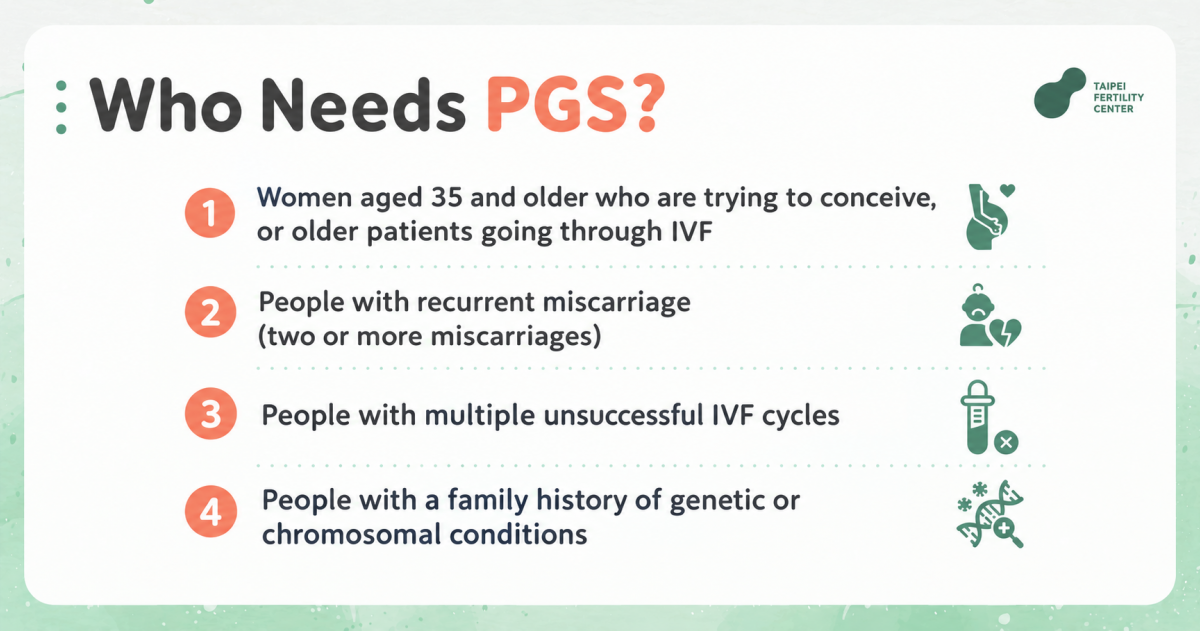
Women aged 35 and older who are trying to conceive, or older patients going through IVF: As a woman’s age increases, so does the chance that an embryo has an abnormal number of chromosomes. PGS can help check whether an embryo has the normal number of chromosomes, which may improve the chances of implantation and lower the risk of miscarriage.
-
People with recurrent miscarriage (two or more miscarriages): Some miscarriages may be linked to chromosome abnormalities in the embryo. PGS can help identify embryos that are more suitable for transfer, which may lower the risk of miscarriage.
-
People with multiple unsuccessful IVF cycles: If you have had several embryo transfers without success, your doctor may recommend PGS to check the chromosome status of your embryos and guide your next treatment steps.
-
People with a family history of genetic or chromosomal conditions:
-
PGT-M: If your family has a known single-gene (monogenic) disorder, such as thalassemia, hemophilia, or a rare disease, PGT-M (formerly PGD) can test embryos for that specific condition and help prevent passing it on to your child.
-
PGT-SR: If one partner is known to have a structural chromosome abnormality, such as a balanced translocation, PGT-SR can help identify embryos with normal chromosome structure, which may reduce the risk of failed pregnancy and miscarriage.
-
Wondering whether PGS is right for you? TFC Taipei Fertility Center is here to support your next step. Book a consultation toda
II. PGS Testing Explained:What Can It Detect? How Does the Process Work?
The PGS process includes embryo culture, cell sampling, chromosome analysis, and selecting embryos that are suitable for transfer. Below, we explain what PGS can detect, its limitations, and the steps involved.
(1)What Can PGS Detect?Understanding What It Tests and Its Limitations
PGS mainly checks whether an embryo has the normal number of chromosomes. It can detect:
-
Abnormal chromosome number (aneuploidy): This includes conditions such as Down syndrome (an extra copy of chromosome 21), Edwards syndrome (an extra copy of chromosome 18), and Patau syndrome (an extra copy of chromosome 13). This helps identify euploid embryos, which have the normal number of chromosomes.
-
Large chromosome deletions and duplications: PGS can detect large pieces of a chromosome that are missing or extra. This may help rule out embryos that are unlikely to develop well because of large structural changes.
However, PGS has technical limitations:
-
It cannot detect single-gene disorders, such as thalassemia, muscular dystrophy, or hemophilia. If you have a family history of this type of condition, your doctor may recommend PGT-M.
-
It cannot fully detect small chromosome deletions, balanced translocations, or small gene variants. If one partner carries a structural chromosome abnormality, such as a balanced translocation, your doctor may recommend PGT-SR.
(2)How Does PGS Testing Worl? A Step-by-Step Guide to Embryo Screening
PGS is usually done as part of IVF, to analyze an embryo’s chromosome status before it is transferred to the uterus. The process includes the following steps:
-
IVF treatment and embryo culture: After egg retrieval and fertilization, the fertilized eggs are cultured in the lab, where their development is monitored. Embryos are usually grown to the blastocyst stage, around Day 5 to 7. Your doctor then decides, based on how the embryo has developed, whether it is suitable for biopsy.
-
Blastocyst biopsy: Once an embryo reaches the blastocyst stage, an embryologist removes a small number of cells from the trophectoderm, the outer layer of the embryo. These cells are the sample used for PGS.
-
Chromosome analysis: The cell sample is sent to a testing laboratory to analyze its chromosome status. A common PGS method today is next-generation sequencing (NGS), which analyzes the copy number of all chromosomes. This shows whether any whole or partial chromosomes are extra or missing.
-
Embryo transfer based on the results: After testing is complete, your doctor will go over the PGS results, the embryo’s development, and other clinical factors with you to decide which embryos are suitable for transfer. When your uterine lining and hormone levels are ready, the frozen embryo is thawed and transferred.
III. How Much Does PGS Cost? Per-Embryo Fees and Total Treatment Costs
PGS is an out-of-pocket expense. Pricing varies by clinic and depends on factors such as the number of embryos tested, the embryo biopsy method, and the laboratory that analyzes the samples. In general, PGS testing costs about NT
18,000toNT25,000 per embryo (roughly US550toUS800). The more embryos you send for testing, the higher the total cost.
Please note that PGS testing fees usually do not include the embryo biopsy or other IVF-related costs. Your actual costs will depend on how many embryos are tested, how your clinic structures its fees, and your individual treatment plan. We recommend talking with your doctor to find the testing option that best fits your situation.
IV. Is PGS Worth it? Understand the Pros and Cons Before You Decide
Whether PGS is worth it depends on your fertility history, your embryo quality, and your treatment goals. Below, we outline the potential benefits and limitations of PGS to help you decide if it may be right for you.
(1)What Are the Benefits of PGS?
-
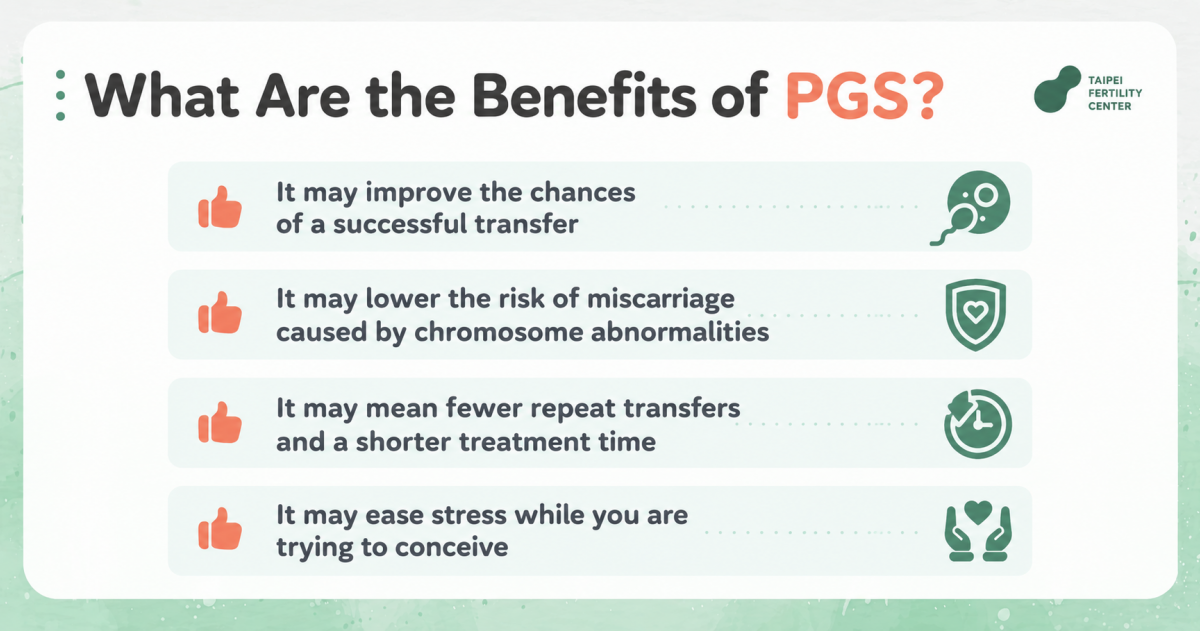
It may improve the chances of a successful transfer: PGS can identify embryos with the normal number of chromosomes, which helps doctors choose embryos that are more suitable for transfer. This may improve the implantation rate and live birth rate per transfer.
-
It may lower the risk of miscarriage caused by chromosome abnormalities: Some early miscarriages are linked to chromosome abnormalities in the embryo. Screening embryos before transfer may reduce the chance of miscarriage from this cause.
-
It may mean fewer repeat transfers and a shorter treatment time: Knowing an embryo’s chromosome status before choosing which one to transfer may lower the chance of repeated unsuccessful transfers. This can save time and reduce the physical and emotional toll of trying again and again.
-
It may ease stress while you are trying to conceive: Embryo screening gives you more information about your embryos and your treatment. This can help you understand where you stand and what comes next, so there is less anxiety about the unknown.
(2)What Are the Drawbacks of PGS?
-
Higher treatment costs: PGS requires an additional embryo biopsy and chromosome analysis, which adds to the overall cost of IVF. Consider your needs and budget, then talk with your doctor about whether PGS is right for you.
-
A possibly longer treatment timeline: With PGS, embryos must be grown to the blastocyst stage before a biopsy is taken. They are then frozen while the results come back, and transfer is scheduled once their chromosome status is known. As a result, the overall treatment timeline may be longer than it would be without PGS.
-
The biopsy may affect the embryo: PGS usually samples cells from the trophectoderm, the outer layer of the blastocyst. Blastocyst biopsy techniques are now well established, and the inner cell mass, which goes on to form the baby, is not sampled. Even so, an embryo biopsy is an invasive procedure, and a small risk to the embryo cannot be completely ruled out. This is why the procedure should be done by an experienced embryology lab.
-
Test results have limitations: PGS mainly checks whether an embryo has an abnormal number of chromosomes. It cannot detect every genetic disorder or gene variant. In addition, because the sample comes from only a few cells in the outer layer of the blastocyst, an embryo may contain both normal and abnormal cells (known as a mosaic embryo). For this reason, even if your PGS result is normal, you should still have prenatal testing as your doctor recommends once you are pregnant.
-
It is not right for everyone: How much PGS helps depends on factors such as the woman’s age, egg quality, the number of embryos, and previous IVF history. If you have only a few embryos, screening may leave you with fewer embryos to choose from. Your doctor will weigh all of these factors to decide whether testing is necessary.
Want to learn more about PGS? TFC Taipei Fertility Center is here to help you prepare for your future family. Book a consultation today
V. PGS FAQs: What to Know Before You Decide
PGS can be a useful reference for people who are planning a pregnancy at an older age, have had recurrent miscarriages or several unsuccessful embryo transfers, or want to improve their chances of success with each transfer. However, if only a few embryos are available, screening may leave you with no embryos suitable for transfer. We recommend discussing this thoroughly with your fertility doctor to decide whether PGS fits your needs.
Q2:How Long does it take to get PGS results?
It usually takes about two weeks to receive PGS results after the embryos are sent for testing. The actual time depends on the testing laboratory and how samples are processed. Because PGS requires an embryo biopsy followed by chromosome analysis, the embryos are frozen while you wait for the results. Once suitable embryos have been identified, your doctor will schedule the transfer.
Q3:How mant embryos should be tested?
There is no fixed number of embryos to test. Your doctor will decide based on your age, embryo quality, the number of blastocysts available, and your treatment needs. Blastocysts with better appearance and development are usually chosen first, to get the most value from testing.
If you have a good number of embryos available, your doctor may recommend testing about 3 to 5 blastocysts to increase the chance of finding embryos with a normal chromosome status.
Q4:Are pregnancy success rated higher with PGS?
PGS can screen out embryos with abnormal chromosomes, which may improve the implantation rate and the chance of pregnancy, and may lower the risk of miscarriage caused by chromosome abnormalities.
However, PGS cannot guarantee a pregnancy. IVF success is also affected by many other factors, such as the woman’s age, egg quality, the condition of the uterus, and embryo development. Even an embryo with a normal PGS result may still fail to implant or may not lead to an ongoing pregnancy because of other factors.
Q5:Do I still need prenatal testing after PGS?
Yes. PGS and prenatal testing serve different purposes. PGS screens the number of chromosomes in embryo cells before the embryo is transferred to the uterus. Prenatal testing takes place after you are pregnant and continues to monitor the mother’s health and the baby’s development. Even if your PGS result is normal, you should still have routine prenatal checkups as your doctor recommends. These may include Down syndrome screening, NIPT, a Level II ultrasound, or amniocentesis, to get a fuller picture of how your baby is developing.
VI. Where Can You Get PGS? TFC Taipei Fertility Center Supports Your Fertility Journey
At every important step of IVF, PGS can give you information about an embryo’s chromosome status, helping doctors and couples plan next steps together. TFC Taipei Fertility Center understands that every patient has different fertility needs. Through a thorough pre-treatment evaluation and discussion among our expert team, we help couples find the fertility plan that suits them best.
TFC is led by Dr. Chi-Jui Tseng, known as the “Father of IVF in Taiwan.” Our team includes physicians who are department directors at medical centers, with an average of more than 20 years of experience, and embryologists who have reviewed more than 10,000 embryos and handled more than 20,000 cycles. They are supported by a professional anesthesia and nursing team. Our laboratory has a 24-hour environmental control system that closely monitors temperature, humidity, air pressure, airborne particles, and volatile organic compounds (VOCs). The facility also has dual uninterruptible power supplies and is built to withstand wind and earthquakes.
To date, TFC has completed more than 3,600 egg freezing cycles for women of all ages. The egg survival rate after thawing is over 99%, the fertilization rate is over 80%, and the overall pregnancy rate is close to 70%, which is similar to the rate with fresh eggs.
On the path to parenthood, TFC cares about not only medical technology but also how patients feel during treatment. With the attentive support of our doctors and team, we help couples understand when PGS is appropriate and what their options are, so they feel less uncertain about treatment. Choose TFC Taipei Fertility Center and let our fertility team help you plan your future with confidence as you work toward welcoming a new life.