












Egg Freezing: Giving You More Choices in Life
In 2014, a cover story in Bloomberg Businessweek ran under the headline “Freeze Your Eggs, Free Your Career.” That same year, Facebook and Apple began offering egg freezing as an employee benefit. This helped more people realize that egg freezing may allow women to pursue their careers without having to delay or give up work for the sake of having children.
A growing body of data also suggests that many women choose to freeze their eggs because they have not yet found the right partner to start a family with. In other words, egg freezing may ease the pressure to rush into trying to conceive before you are ready, simply because of your age.
In the long run, as egg freezing technology matures, it can give women greater freedom in both career planning and life choices. You do not have to let your reproductive timeline dictate your plans, and you can map out your life on your own terms.
Who Should Consider Egg Freezing?
Before we talk about egg freezing, it helps to understand the egg itself. Egg quality is the main factor affecting pregnancy and live birth rates. As a woman ages, the number of oocytes in her ovaries also declines year by year.
Ovarian function is generally assessed using three indicators:
1. Age
Age is the most important factor affecting a woman’s fertility. According to published studies, the pregnancy rate for women under 35 undergoing in vitro fertilization (IVF) is about 30%. For women over 40, it drops to about 10%, and after age 42 it falls below 5%.
Read more: Is there an age limit for egg freezing? Make the most of your window. This is the best age to freeze your eggs!
2. Antral follicle count (AFC) on days 3-5 of the menstrual cycle
On days 3-5 of the menstrual cycle, a transvaginal ultrasound is used to count the antral follicles, which measure 2-10 mm in diameter, in both ovaries. The antral follicle count helps predict ovarian reserve, how the ovaries are likely to respond to ovulation induction, IVF success rates, and live birth rates. It can also help estimate the risk of ovarian hyperstimulation syndrome (OHSS). In general, an AFC of 15-30 indicates normal ovarian function. An AFC below 6 suggests diminished ovarian reserve and a reduced response to stimulation. An AFC above 30 suggests a high reserve, which significantly raises the risk of OHSS.
3. Anti-Müllerian hormone (AMH) level
What it shows: an estimate of the number of eggs currently stored in the ovaries.
Unit: ng/mL
Suggested reference range for a healthy 28-year-old woman: 3-6 ng/mL

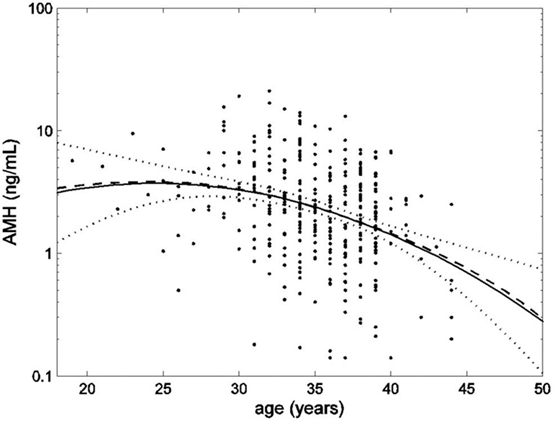
Reference: La Marca A, Sighinolfi G, Papaleo E, Cagnacci A, Volpe A, et al. (2013) Prediction of Age at Menopause from Assessment of Ovarian Reserve May Be Improved by Using Body Mass Index and Smoking Status. PLoS ONE 8(3): e57005. doi:10.1371/journal.pone.0057005.
A high AMH level suggests an ample supply of follicles in the ovaries. A low AMH level suggests a diminished follicle reserve, which may mean higher doses of ovulation-induction medication are needed and a lower likelihood of treatment success. The ideal AMH range is about 3-6 ng/mL. A level below 1 ng/mL suggests the follicle reserve has declined and ovarian function is already significantly reduced. In this case, it is advisable to try to conceive sooner rather than later.
Egg freezing as “fertility insurance”
In modern society, more people are marrying later and, as a result, having children later. Egg freezing can be thought of as a form of “fertility insurance”: while you are young and your ovarian function is still in its prime, you can preserve your healthier, more fertile eggs for the future.


So Who Is a Good Candidate for Egg Freezing?
You may want to consider egg freezing if you fall into one of the following groups:
- Women of advanced reproductive age: Women aged 35 or older who have no immediate plans for marriage or children.
- Younger women with low ovarian reserve: Young, unmarried women whose AMH level, an indicator of egg supply, is below 2 ng/mL.
- Endometriosis (including endometriomas, or “chocolate cysts”): Women with moderate to severe endometriosis who have not yet completed their family.
- Malignant tumors: Women with cancer who are preparing to undergo chemotherapy or radiation therapy.
- Uterine factors: Women who have no uterus or whose uterine function is impaired and who are waiting for surrogacy legislation to pass.
- Azoospermia: During an IVF cycle, if sperm cannot be retrieved from the male partner on the day of egg retrieval, the eggs must be frozen first under Taiwan’s legal restrictions while a match with a sperm bank is arranged.
- Other situations:
- Any young woman may freeze her eggs in advance as part of her life planning.
- Women with a family history of premature ovarian insufficiency (POI) or an autoimmune condition may also consider it.
- If more than 25 eggs are retrieved during an IVF cycle, some of the surplus eggs can be frozen and donated to help others once the patient has successfully had a child.